November 1986: “The Warning Should Not Go On Unheeded”
November 1986 unfolded under the shadow of revelations that shook Washington and rippled far beyond it: the Iran‑Contra Affair burst into public view when a Lebanese magazine exposed secret U.S. arms sales to Iran and the covert funding of Contra rebels in Nicaragua. As the world absorbed the implications of a superpower caught operating in the grey zones of geopolitics, Northern Ireland faced its own familiar turbulence; a month marked by paramilitary activity, political strain, and communities bracing against the next turn of the conflict. In both arenas, November 1986 revealed how hidden decisions made in back rooms and foreign capitals could shape the lives of ordinary people, whether in Central America or on the streets of Belfast and Derry.
Political Developments in November 1986
November 1986 opened with Unionist leaders taking their campaign against the Anglo‑Irish Agreement across the water. On the 1st of November, James Molyneaux and Ian Paisley stood before an Orange Order rally in Glasgow, using the occasion to launch a fresh British‑based offensive against the Agreement they believed undermined Northern Ireland’s constitutional position. The next day, in Dublin, Sinn Féin delegates were wrestling with their own historic question. After years of abstentionism, the Ard Fheis voted to end the policy and take seats in the Dáil. The decision fractured the movement: Ruairí Ó Brádaigh, Dáithí Ó Conaill, and around a hundred supporters walked out, soon forming Republican Sinn Féin.
Tensions between London and Dublin surfaced again on the 4th when it emerged that Margaret Thatcher had rejected Irish government proposals to expand Diplock courts from one judge to three. Three days later, the dispute over the Anglo‑Irish Agreement spilt into civic ritual. Sammy Wilson, then Lord Mayor of Belfast, barred Northern Ireland Office ministers from attending the Remembrance Day service at City Hall, a symbolic snub aimed squarely at the Agreement.
By the 10th of November, Loyalist resistance was taking on a more organised form. At a closed meeting in the Ulster Hall, Paisley, Peter Robinson and Ivan Foster addressed supporters and announced the creation of Ulster Resistance, a group vowing to take “direct action” to bring down the Agreement. Two days later, the Queen’s Speech at Westminster reaffirmed the British government’s commitment to that same Agreement, underscoring the widening gulf between London and Unionist opinion.
The first anniversary of the Agreement on the 15th of November brought thousands of Unionists and Loyalists to Belfast City Hall for a major demonstration. The protest ended in clashes with the RUC and damage to nearby shops, a reminder of how volatile the political atmosphere had become. On the 17th, Peter Robinson escalated matters further by defying a ban and marching through Portadown in paramilitary‑style uniform alongside members of Ulster Resistance.
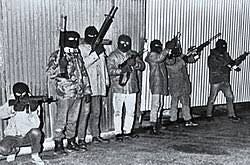
Unionist leaders continued their political outreach on the 18th of November, with Molyneaux and Paisley travelling to London to meet Labour leader Neil Kinnock. But the month also saw paramilitary theatrics from the opposite side of the conflict. Around the 20th, at least fifteen INLA members were photographed posing with automatic weapons in South Armagh, an image that angered Unionist politicians and prompted NIO minister Nicholas Scott to back new laws targeting paramilitary displays.
The SDLP added its voice on the 21st of November, using its annual conference in Newcastle, County Down, to reject Unionist calls for suspending the Anglo‑Irish Agreement. As the month drew to a close, internal Unionist divisions resurfaced. On the 26th, UUP councillors voted against mass resignations from district councils, despite pressure from party leadership. That same day, the Standing Advisory Commission on Human Rights recommended expanding Diplock courts to three judges, though it opposed restoring jury trials for scheduled offences.
Finally, on the 28th of November, the Fair Employment Agency published a report concluding that government‑sponsored job distribution did not disadvantage Catholics; an assessment that cut against long‑standing claims of structural bias and added yet another layer to an already charged political landscape.
Tales of the Troubles is a reader‑supported publication. Thousands read it — but only subscribers get every instalment, every detail, every story as it lands. Don’t be the one hearing about it second‑hand.
Shootings & Other Incidents in November 1986
November 10th.
Off-duty RUC member Derek Patterson (39) was shot and killed by the Irish People’s Liberation Organisation (IPLO) outside a friend’s home on Fitzroy Avenue, off the Ormeau Road, in Belfast.
November 14th.
Protestant civilian Alan McCormick (29) was killed when he was knocked down by an RUC land rover during street disturbances on Bilston Road in Ballysillan.
If you’d like to support the newsletter, why not buy me a ☕️ ?
Bombings in November 1986
November 8th.
Two bombs planted by the UFF exploded in litter bins on Dublin’s main street but caused no deaths or injuries, and two others were found and defused. The following day, a UFF spokesman said the UFF had “the potential to cause death and destruction” and that “the warning should not go on unheeded”.
November 11th.
Eleven hoax bomb warnings at various businesses on Dublin’s Grafton Street and Dawson Street caused significant disruption across the city. The UFF is believed to be behind the hoaxes.
November 14th.
In an IRA attack on an RUC base in Newry, the bombs fell short of their target and landed on residential homes. 39 civilians were injured, including a four-year-old Catholic girl. The IRA issued a statement afterwards which read.... “this incident left us open to justified criticism”.
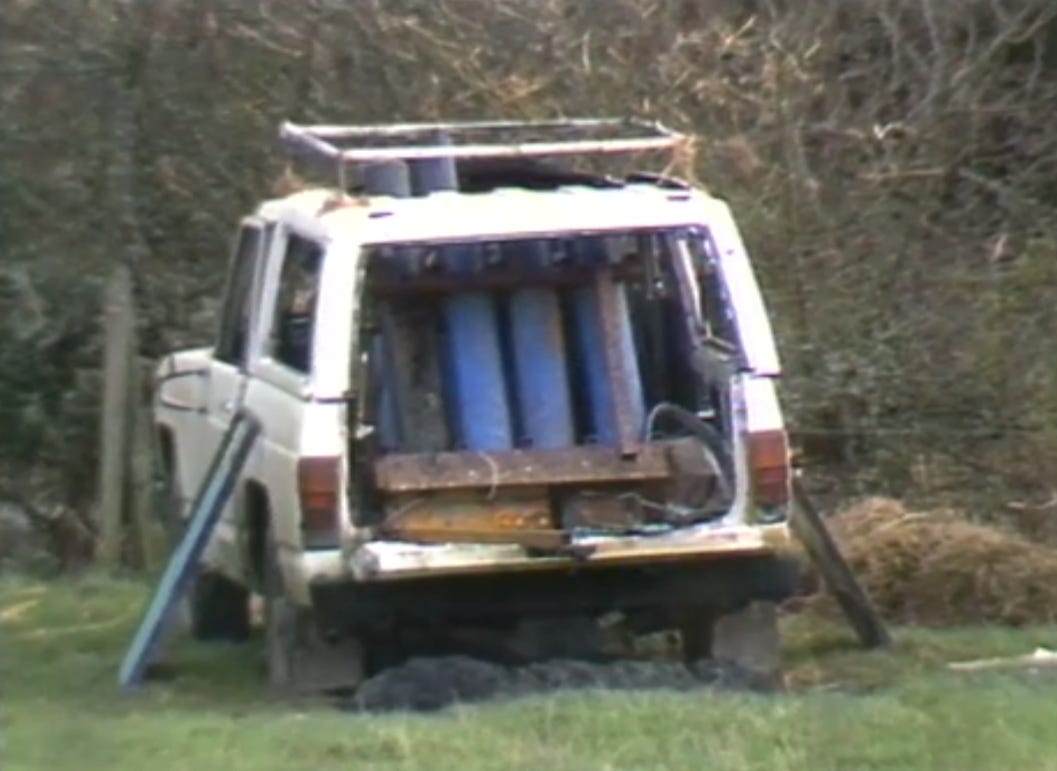
A massive IRA bomb containing 500lbs of explosives and 200lbs of metal pieces packed into a 40-gallon drum was left at the side of Corgary Road at Cadtledreg, Co. Tyrone, with a command wire leading across the Irish border. The device was safely defused.
November 15th.
The Protestant Action Force claimed responsibility for a 3–4 lb (1.4–1.8 kg) bomb a taxi driver was forced to take from the Shankill Road to North Queen Street RUC barracks in Belfast. A British Army bomb disposal team neutralised the device.
November 23rd.
Six British soldiers were wounded after the IRA launched seven mortars at a British Army barracks in Middletown, County Armagh.
November 24th.
The INLA hurled a grenade at the home of Unionist Party Councillor Sam McCarney in Downpatrick. It failed to detonate and was later defused by the British Army.
Thanks very much for reading. I hope you found it interesting and will come back on Sunday!
I appreciate everyone who recently clicked the heart icon ❤️ at the bottom. It makes it easier for others to find this newsletter.
Thanks for the support!
If you’d like to let me know what you think of today’s instalment, please comment below.
Some recommended reading based on research for this instalment.
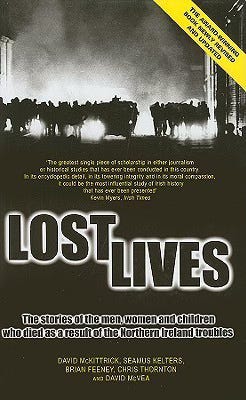
Lost Lives: The Stories of the Men, Women and Children Who Died as a Result of the Northern Ireland Troubles by David McKittrick, Chris Thornton, Seamus Kelters and Brian Feeney.