May 1985: The £2m Target
May 1985 unfolded in Northern Ireland with a familiar mix of tension, political manoeuvring, and the grinding weight of a conflict that refused to loosen its grip. Yet beyond these shores, the world was also confronting the fragility of peace. In early May, a devastating fire swept through the Valley Parade stadium in Bradford, claiming 56 lives and shocking Britain into a moment of national grief. As Northern Ireland navigated its own turmoil, sectarian killings, security crackdowns, and the uneasy dance between London, Dublin, and local parties, the tragedy in Bradford served as a stark reminder that violence and loss were not confined to conflict zones.
Political Developments in May 1985

Politically, May began with an update on the hopes for a future devolved Government in Northern Ireland on the 8th. Parliamentary Under-Secretary for the Northern Ireland Office Chris Patten provided an update on discussions with Party leaders. it read;
POLITICAL DEVELOPMENTS: TALKS WITH PARTY LEADERS
1. With the exception of the DUP (to whose position I shall return), I have now had 2 rounds of substantive talks with the leaders of the Northern Ireland political parties. On one occasion, I met Hume with McGrady, Hendron and Mallon. I have also met the Report Committee of the Assembly. All these discussions have been good-humoured and interesting up to a point; the point being that no one has ventured much beyond the long dug party trenches. I had always intended to pause at this moment, while the district council election campaign stormed to its conclusion and while, in its aftermath, we sought to assess how best to retain the relationship between central and local Government. It may be an appropriate moment to offer you and colleagues some personal reflections, to supplement the full notes made of my meetings. These reflections lean heavily on the views of officials, though in one or two major particulars my main support is my own prejudices.
2. Let me begin with our objective. We seek a form of devolved government for Northern Ireland which is widely acceptable to the whole community. The 1982 White Paper and Act gave the general outline of what we are seeking (for example, a body that legislated as well as administered) but did not spell things out. Our position has been that pretty well anything on which the parties can agree within this framework will suit us, provided that it is widely acceptable - a phrase whose meaning, I suspect, is fairly plain to most of those who have tried and failed to extract a clearer definition from us.
3. We pursue this objective within tight constraints:
(a) The search for a form of devolved government for Northern Ireland cannot be divorced from the attempt to secure a more solid working relationship between London and Dublin. The SDLP are not going to get involved in internal arrangements that make Northern Ireland more stable unless the context of the Northern Ireland political debate is changed by London and Dublin. Equally, any change which goes too far will drive the Unionists into their “laager” for at least the time being. An agreement between London and Dublin might be worthwhile even if it is not accompanied or followed by improved internal arrangements. Yet since one of the purposes of Anglo-Irishry is a better political climate in the Province, failure to make progress internally would obviously represent a sizeable reduction in the benefits accruing from a deal with Dublin (although I accept that there may be different time-scales on each of these tracks). While the linkage between the “twin tracks” cannot be ignored, there seems little likelihood of bringing both to the desired terminus at the same time, as happened at Sunningdale. All the parties will want to see what London and Dublin have decided before they commit themselves to anything in Belfast. The most we could expect from the political parties at the same time as a Summit deal is concluded is a commitment from that party (the SDLP), which has boycotted the main forum for political development, to engage in the search for acceptable arrangements whose outline might be made clearer at this point by the Government.
(b) It would be difficult to explain how any arrangements could be regarded as widely acceptable unless the SDLP agreed to them. The SDLP will not agree to any arrangements without a Summit deal which almost by definition must be acceptable to them since if it is not the Fitzgerald government will have difficulty defending it. Nor will the SDLP agreed to any arrangements which fall much short of what they accomplished in 1973-74. If the Unionists are to be given any power, then the SDLP want a share of power themselves. This is doubtless what the Unionists would call a double veto.
(c) In looking for a solution we have recognised all along that we may be able to get round every base with one hit. Partial devolution has therefore been canvassed, though it is seen to be administratively messy and may also be based on the inaccurate assumption that it would be more difficult to agree on a lot than a little. Any other form of partial solution, which may be tailored to meet the objections of one of the parties or the interests of good government, is deemed out of court on the grounds that if the powers returned to Belfast are more limited than those offered in 1982, then ipso facto devolution as a policy has been abandoned, and we are settling for Unionist integration with a dressing on top. If we continue to accept this argument then it is clear that we have precious little room for manoeuvre.
4. In brief, the constraints are that there are not going to be any internal arrangements without a Summit deal of which the SDLP approve; any internal arrangements will have to be built on power sharing; and under our present policy, there are really no alternatives to administrative and legislative devolution.
5. My talks with the parties cast some light on these familiar difficulties:
(a) The SDLP are prepared, with the proviso of an acceptable Summit deal, to get involved in attempting to secure internal arrangements. This is not the preferred route of the party leadership as expressed to me. They would most like electoral reform for Westminster elections since they do not really like any power being exercised by local politicians from Belfast: by definition some of these politicians will be Unionists. But if everyone insists on a devolved government, they are prepared to go along with the idea so long as it is on the same basis on which they enjoyed power a decade ago. Magnanimously, they will concede power sharing if power has to be devolved.
(b) Both the OUP and the DUP are prepared to accept proportionality of appointment to offices in this Assembly which has no power, but they are not prepared to share any power which may be devolved to the Assembly. The OUP say that because they recognise that we would not be prepared to proceed on this basis, they are only seeking the erection of an upper tier of local government for Northern Ireland such as the rest of the UK enjoys. (Actually, it doesn’t, but that is a minor quibble.) The precise remit of such a regional council is blurred at the edges; it corresponds more or less closely to full administrative devolution according to which Unionist you address and which audience he or she addresses. But what the OUP argue officially is that administrative devolution must be separate from legislative, which is not negotiable. The point is not made as explicitly as that; no point is made as explicitly as that by the OUP. But if the OUP mean anything much at all, that is what they mean. There is a view that the integrationist OUP faction does not speak for the party which it happens to lead, and that grassroots supporters in Fermanagh or elsewhere will not put up with an integrationist lead for much longer when something more may be on offer. A personal sympathy for the logic of the OUP position possibly exaggerates the extent to which I believe that the Fermanagh rebellion is an advanced form of the wish being father to the thought.
(c) The Alliance want the smack of firm government. They want us to set out in terms our own thoughts on devolved government and to tell the parties to get on with it or else - the “or else” being a form of Direct Rule which will make everyone who has stood in the way of an acceptable form of devolved government uncomfortable as well as cross. They attack the SDLP for blocking internal progress, yet they favour the sort of partnership government on which the SDLP would insist and which would possibly lead to a Unionist black-ball.
(d) The DUP have so far refused to talk to me about internal arrangements, because they say we have not yet given adequate assurances that Dublin is not involved in determining what these arrangements should be. We await another letter from them on this point. It looks as though, at least for the duration of the District Council election campaign, they have concluded that caution dictates an arms-length approach to a process which might include a Summit deal completely unacceptable to their supporters. Nevertheless, Robinson and Allister came to the Report Committee lunch and the DUP’s position is clear. They want full devolution, on a basis which is as widely acceptable as possible. If they cannot have this, then they will settle for legislative devolution on the grounds that it was administration not legislation which caused problems in the past. They could not contemplate power sharing because - a new gloss on an old argument - this might involve sharing power with Sinn Féin.
6. Where does this all leave us? I am convinced that whether there is a Summit deal or not, the time is coming when we must be explicit about what sort of devolved government would pass our test of acceptability. At the very least, we cannot set devolution as our objective for years and then let the attempt to establish a devolved government drain into the sand without our setting out what exactly we wanted to achieve. I am also convinced that in describing our own preferred model we shall have to be explicit about widespread acceptability, ie, power sharing, partnership, proportionality or whatever we decide to call it.
7. The argument might go like this. This Assembly has done much useful work. But it has not, for various reasons, carried out its main task. It has not devised a form of devolved government in line with the 1982 Act. There will be no point in having elections to a new Assembly just like the present one. Such an Assembly would be a destabilising, not a stabilising force. The next Assembly elections should therefore be for a body whose evolution into the sort of devolved government envisaged in 1982 has been accepted in advance by the political parties who will contest them. Where possible that devolved government should grow directly out of the 1982 legislation and the experience of the existing Assembly. In order for it to be widely acceptable, appointments should as now be proportionate to party strength. The chairmen of the committees thus appointed would act as heads of the departments responsible for the transferred services with the exception of finance; a function which would be retained along with his other powers by the Secretary of State. In order to secure enough jobs, some of the existing departments could be broken up into smaller units, or we could appoint deputy departmental heads too. There would need to be a distinction between the powers of committees and those of heads of departments, which might argue for distinguishing between committee chairmanships and departmental posts. The Secretary of State would call departmental heads together as and when necessary, for example, to discuss financial allocations.
8. I raise at this stage two fundamental points about this model:
(a) I believe we should leave open for negotiation the question of whether or not legislation should be devolved as well as administration. (We could, for instance, put forward two models, one with full devolution and one with administrative devolution alone.) I am told that without legislation, there is no real devolution, and that the Republic and the SDLP would regard the consequences as intolerably integrationist. I have always had my doubts about this: although under the terms of the 1982 Act, both the legislative and executive functions have to be transferred to a devolved Assembly. Administrative devolution on its own is more messy in some ways than administrative and legislative devolution and less so in others. If we were to be able to make some concession to Unionists on legislation without frightening off the Republic or the SDLP, this would surely be a considerable gain. Admittedly, it is, however, a very big ‘if’. We would be creating a regional council, though one with far more extensive powers than any other local authority possesses (and one which will need to operate on our “widespread support” basis). The argument that this would represent the abandonment of our commitment to devolution seems extreme. We are not advocating devolution because we believe in it per se; plainly we do not. We are attracted to devolution because it obliges local politicians to work together. Whether this is achieved with or without a legislative role is neither here nor there; what matters is that it is achieved somehow.
(b) Some Unionists argue that proportionality or power sharing might be more acceptable if it was not made obligatory by law. There is of course an artificiality about this point. If the parties are prepared voluntarily to share power, there is no need for a statutory obligation, and if there is a statutory obligation, but no voluntary acquiescence, then the whole edifice tumbles down anyway. In political terms, however, it is important, and we may have to consider whether there is some way in which the Assembly could bind itself to act in this way either each time a new Assembly was elected or for the period of, say, two Assemblies. We may also need to deal with the DUP point about Sinn Féin, bearing in mind the relevance of any decision to local government.
9. I have one further policy consideration. I am concerned about the lack of continuing leverage on the SDLP in the event of a Summit deal. They may express their general intention to get involved in internal arrangements, provided that Anglo-Irishry works out satisfactorily, and then find reasons for sliding away from any substantive talks or agreements. I am still of the view that Anglo-Irishry should be considered as a continuing process, the machinery of which should be open to periodic (say, annual) review by the AIIC. One of the aspects of an annual review would be the effects of new machinery on the internal political situation, and there would in these circumstances be continuing pressure on the SDLP to live up to their side of an implicit bargain. I do not suggest anything mechanistic, only that we should not place ourselves in a considerably less advantageous position than everyone else.
10. If, regardless of whether or not the talks with Dublin are successful, we believe that we should shortly be in a position to set out our preferred political course for Northern Ireland, then drafting will have to begin very soon. I assume that a discussion document might also want to touch on other issues, such as the consolidation and strengthening of our human rights and community relations efforts, and the symbolic minority tradition issues.
11. Whether I should resume my talks after the district council elections is an evenly balanced question. I am slightly reluctant to do so unless there is something into which we can all sink our teeth; and if we are a bit clearer about what we want and actually start to indicate what it is, sooner rather than later the whole world will be in receipt of a garbled version. If we do not want to start pressing the case for a particular model, then there is not much left to talk about, though I could certainly spin out another round of the talks without too much difficulty should it be felt that we need to avoid creating a summer vacuum. My inclination at present is to defer this question until late May when the internal situation may be clearer, assuming some signs of development on the Dublin track. I appreciate that whenever things start to get more serious you yourself will wish to get involved directly. Whichever course we decide to follow, we shall need a line for the press and for political consumption.
District Council elections took place across Northern Ireland on the 15th, marking Sinn Féin’s first entry into local government contests. When the counting was complete, the party had secured 11.8 per cent of the vote and won 59 seats — a notable breakthrough in its electoral journey.
Later in the month, on the 26th, the Lear Fan aircraft company announced it was closing its Northern Ireland plant. The decision brought an abrupt end to the venture and left most of its 350 employees without work, dealing another blow to the region’s already fragile industrial landscape.
Tales of the Troubles is a reader‑supported publication. Thousands read it — but only subscribers get every instalment, every detail, every story as it lands. Don’t be the one hearing about it second‑hand.
Shootings in May 1985
May 3rd.
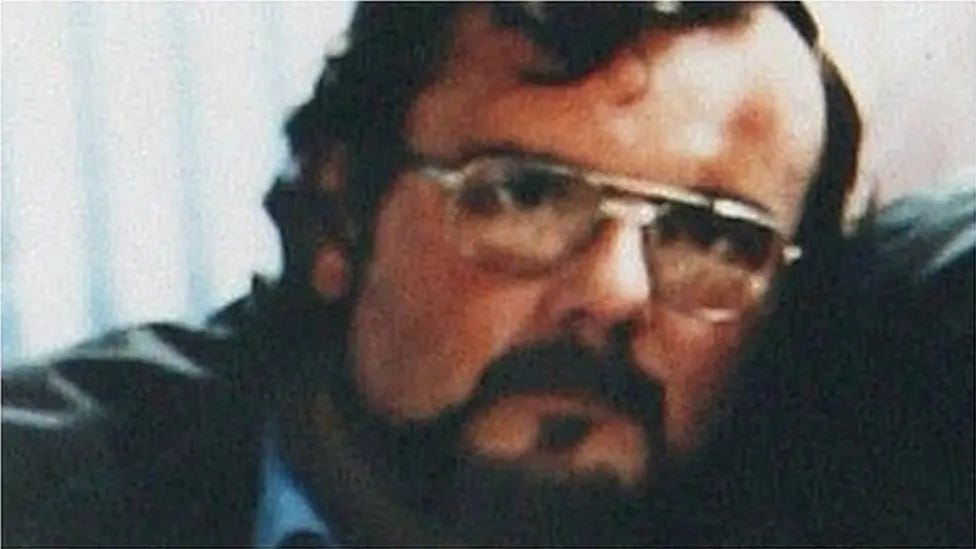
The IRA shot and killed former Ulster Special Constabulary officer William Heenan (51) at his home in Leitrim, near Castlewellan. The IRA claimed the man was an RUC reservist and had been seen regularly at roadblocks. However, the RUC denied this, and he is listed in numerous places as a civilian.
May 9th.
The INLA abducted and killed former member Seamus Ruddy (33) in France. The 33-year-old from Newry, County Down was found at Pont-de-l’Arche, near Rouen in northern France in May 2017.
May 15th.
INLA snipers opened fire on RUC officers, who returned fire, in the Galliagh area of Derry.
May 24th.
An RUC officer was injured after several shots were fired at a police patrol on Spencer Road in Derry. RUC officers returned fire. It was one of several gun attacks on the security forces by the INLA in Derry that summer, including another incident in which an RUC officer was injured.
May 28th.
Civilian Gary Smith (19), who had just applied to join the RUC, was shot and killed by the IRA as he parked his car in Millfield, Belfast.
May 31st.
The INLA tried to assassinate IRSP/INLA member Gerry Roche in Cratloe near Shannon in County Clare as part of an internal dispute. Allegedly, the INLA Chief of Staff John O’Reilly’s gun jammed, and a second attacker fired several shots but missed. A third gunman refused to fire at his former party chairman.
If you’d like to support the newsletter, why not buy me a ☕️ ?
Bombings in May 1985
May 11th.
A bomb intended for the security forces in the Poleglass area of Belfast failed to detonate and sat unattended for nearly two days. The IRA said a fault developed in the remote control mechanism.
May 14th.
The INLA claimed responsibility for two incendiary devices planted in business premises in Belfast city centre.
May 20th.
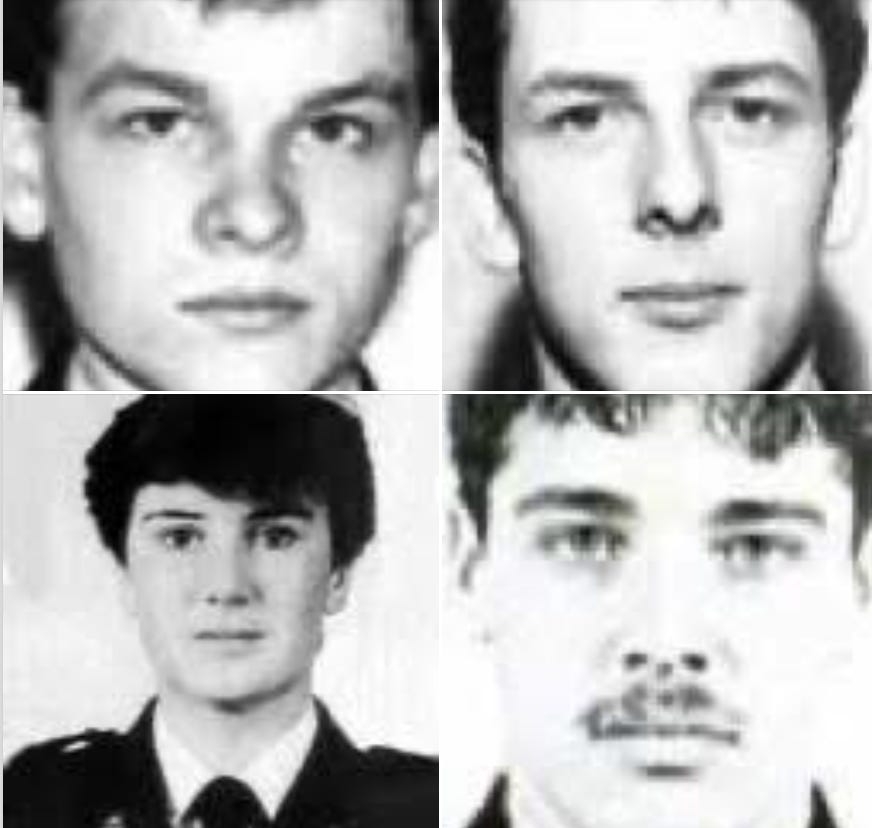
RUC officers David Baird (22), Tracy Doak (21), Stephen Rodgers (19), and William Wilson (28) were killed by an IRA remote-controlled bomb in Killeen, County Armagh, while serving as part of a police escort for an armoured car transporting £2 million from Dublin to Belfast. The escort had just met the security van on the border when the first armour-plated RUC vehicle was hit by a 1,000 lb (450 kg) roadside bomb. The vehicle was completely destroyed.
Thanks very much for reading. I hope you found it interesting and will come back on Sunday!
I appreciate everyone who recently clicked the heart icon ❤️ at the bottom. It makes it easier for others to find this newsletter.
Thanks for the support!
If you’d like to let me know what you think of today’s instalment, please comment below.
Some recommended reading based on research for this instalment.
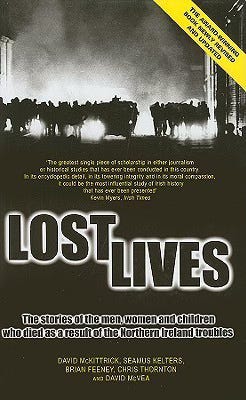
Lost Lives: The Stories of the Men, Women and Children Who Died as a Result of the Northern Ireland Troubles by David McKittrick, Chris Thornton, Seamus Kelters and Brian Feeney.