May 1984: Crisis Management
As May 1984 unfolded in Northern Ireland, the Troubles continued to grind on with their familiar mix of political strain, street‑level tension, and the ever‑present threat of violence. Yet beyond these shores, the world was also tightening along its own fracture lines. On the 8th of May, the Soviet Union declared it would not participate in the upcoming Los Angeles Olympics, framing the decision as a response to Western hostility. The announcement sent a symbolic shock through global politics: a reminder that even the supposedly unifying realm of sport could be pulled apart by geopolitical rivalry. In this month’s instalment, the events in Northern Ireland sit against that wider backdrop of boycotts, brinkmanship, and deepening divides; two very different arenas, yet both shaped by the same underlying question of how communities navigate conflict, identity, and power.
Political Developments in May 1984
May opened with the conclusion of a major ‘supergrass’ trial on the 1st, as informer Robert Quigley’s evidence led to ten people being sentenced to jail.
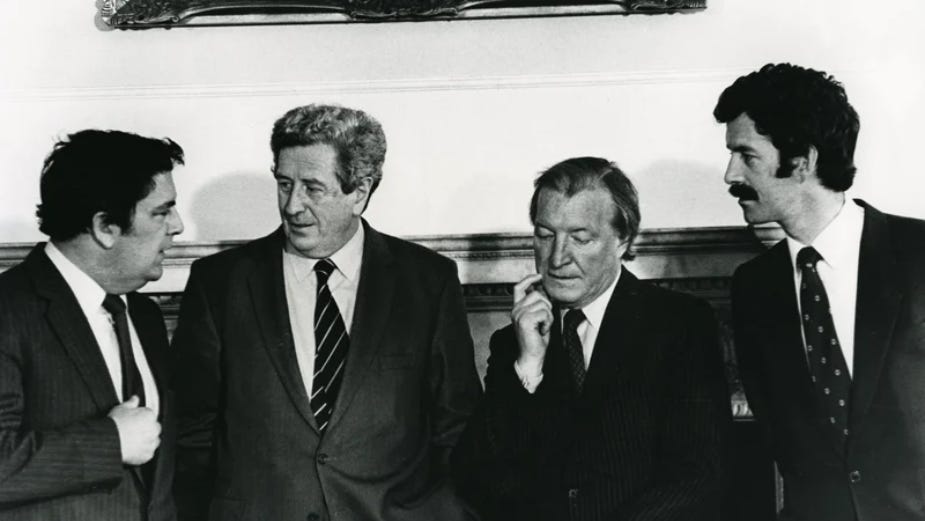
The following day, the long‑awaited Report of the New Ireland Forum was published. Its authors criticised what they described as Britain’s policy of “crisis management” since 1968 and outlined three constitutional options for Northern Ireland’s future: Irish unity; joint authority between London and Dublin; or a federal or confederal arrangement. Fianna Fáil leader Charles Haughey insisted that unity was the only viable path. The report also rejected the use of violence as a means of achieving political change.
The British Government issued a response to the New Ireland Forum report. It read;
RESPONSE TO REPORT OF NEW IRELAND FORUM
The following statement is issued today on behalf of HMG by the Rt Hon James Prior MP, Secretary of State for Northern Ireland, in response to the publication of the report of the New Ireland Forum:
“The problems faced by our fellow citizens in Northern Ireland are grave. That much at least is common ground. The continuing problems of the Province demand that we give attention to all responsible views. The Government will study the Forum Report carefully and also reactions to it, not least in Northern Ireland itself.
The authors of the Report (all the main parties in the Republic and one party from Northern Ireland) cannot expect the Government to accept the Nationalist interpretation of past events which the Report expresses, or the dismissal of the strenuous efforts which successive United Kingdom governments have made in the past 15 years to deal with the intractable problems of Northern Ireland. The Forum’s account of the British position is one-sided and unacceptable.
Nevertheless, the Government welcomes important positive elements in the Report. First, there is a clear and unambiguous reaffirmation of the commitment of the Forum participants to the politics of peaceful persuasion and unqualified opposition to violence and those who support violence. The Report also confirms the established position of successive Irish governments that unity is sought on a basis “freely negotiated and agreed to by the people of the North and by the people of the South.” In seeking such agreement, the Report includes a considered attempt by Nationalists to recognise and respect the distinctive identity of Northern Ireland Unionists, including their loyalty to the United Kingdom.
The Government stands by its undertaking that Northern Ireland shall not cease to be part of the United Kingdom without the consent of a majority of the people of Northern Ireland and remains willing to give effect to any majority wish which might be expressed in favour of unity. But Unionist opposition to Irish unity is to the principle rather than the form. As the Report acknowledges, consent has to be freely given. And there is no reason to expect such consent to a change in sovereignty in Northern Ireland in any of the three forms suggested in the Report.
It remains necessary to face the problems of division and violence in Northern Ireland, including the feelings of alienation among the Nationalist minority. The Government’s continuing objective is to provide a basis on which all its inhabitants - Unionist and Nationalist - can live securely, peacefully and prosperously in the years immediately ahead, giving full expression to their identities and aspirations and playing their proper part in public affairs. The Government is ready to consider with all those who renounce violence ways in which this objective can be achieved.
The United Kingdom government welcomes the statement in the Report that the parties in the Forum remain fully open to discuss other views.”
Tensions surfaced within republican circles on the 6th, when four armed and uniformed INLA volunteers attempted to seize the platform at a Sinn Féin rally commemorating the 1981 Hunger Strike. Stewards blocked their advance. The group was protesting Sinn Féin’s refusal to allow speakers from the IRSP to take part.
A political movement followed later in the month. On the 23rd, the Ulster Unionist Party announced it would end its boycott of the Northern Ireland Assembly.
The next day, Deputy Chief Constable John Stalker of Greater Manchester Police arrived in Belfast to begin investigating allegations of a “shoot‑to‑kill” policy by security forces. His inquiry centred on three controversial incidents from November and December 1982. Although he pursued the investigation for several years, Stalker was abruptly removed from his post in May 1986 just as he was preparing to begin its final phase. He was later reinstated but never permitted to return to Northern Ireland.
Security concerns remained high. On the 25th, large quantities of explosives were uncovered in County Tyrone and County Down. That same day, both houses of the United States Congress unanimously endorsed the New Ireland Forum’s report, giving it significant international backing.
The month closed on a bleak economic note. On the 31st, the Belfast‑based Lear Fan aircraft company announced that almost all of its 350 jobs would be lost. The firm ceased trading in May 1985, despite receiving £45 million in government investment since 1980.
Tales of the Troubles is a reader‑supported publication. Thousands read it — but only subscribers get every instalment, every detail, every story as it lands. Don’t be the one hearing about it second‑hand.
Shootings & Riots in May 1984
May 6th.
There were riots in Nationalist areas of Belfast and other towns following the third anniversary of the death of Bobby Sands on hunger strike.
May 8th.
Off-duty UDR soldier James Johnstone (28) was shot and killed by the IRA in the car park of Drumglass Hospital in Dungannon.
May 12th.
Off-duty UDR soldier Ivan Hillen (46) was shot and killed by the IRA at his farm in Lismore, near Augher in County Tyrone.
May 14th.
Civilian Seamus Fitzsimmons (21) was shot and killed by undercover RUC members during an attempted robbery at a Post Office in Ballygalley, near Larne.
May 17th.
Northern Editor of the Sunday World, Jim Campbell, was shot and seriously injured by the UVF at his home in North Belfast.
If you’d like to support the newsletter, why not buy me a ☕️ ?
Bombings in May 1984


May 4th.
The INLA hijacked a lorry carrying gas cylinders and forced the driver to take an incendiary device to Woodbourne RUC station in West Belfast. The INLA opened fire on RUC officers as they evacuated the area. The device later detonated, and several gas cylinders exploded.
May 9th.
Off-duty British Army Territorial Army soldier Trevor May (28) was killed by an IRA booby trap bomb while travelling in his car shortly after leaving his workplace at the Telephone Exchange on Downshire Road in Newry.
May 16th.
Three RUC officers escaped serious injury after their patrol car was hit by a large IRA landmine in County Armagh.
May 18th.
RUC officers Trevor Elliott (28) and Neville Gray (25) were killed when the IRA exploded a landmine as their armoured patrol car travelled in Lislea, near Camlough, County Armagh.
Off-duty British soldiers Thomas Agar (35) and Robert Huggins (29) were killed, and another, Peter Gallimore (27), died 11 days later as a result of his injuries, after the IRA planted a booby trap bomb under their car outside the Lakeland Forum Leisure Centre in Enniskillen. The soldiers were off-duty at the time and had just competed in a fishing competition.
May 28th.
A bomb attack targeting British soldiers on the Ballymurphy Road in Belfast was foiled by the RUC. INLA members were arrested in two houses they had taken over for the operation. A 40 lb (18 kg) bomb planted nearby was defused.
May 29th.
British soldier Stephen Anderson (22) was killed in an IRA landmine attack in Mounthill, near Crossmaglen, County Armagh. That same day, an IRA bomb on the Whiterock Road in Belfast was defused by the British Army.
Thanks very much for reading. I hope you found it interesting and will come back on Sunday!
I appreciate everyone who recently clicked the heart icon ❤️ at the bottom. It makes it easier for others to find this newsletter.
Thanks for the support!
If you’d like to let me know what you think of today’s instalment, please comment below.
Some recommended reading based on research for this instalment.
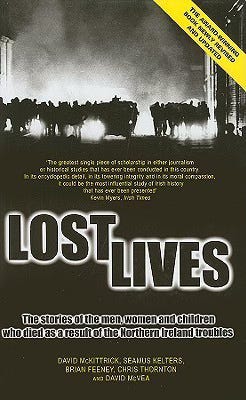
Lost Lives: The Stories of the Men, Women and Children Who Died as a Result of the Northern Ireland Troubles by David McKittrick, Chris Thornton, Seamus Kelters and Brian Feeney.