March 1982: "Unworkable"

A month marked by tension at home and turbulence abroad, March 1982 saw Northern Ireland gripped by the grinding, uneasy rhythm of the Troubles while the wider world confronted its own turning points. As local communities in Northern Ireland faced continuing security pressures and political stalemate, Argentina’s move onto South Georgia on the 19th of March set the stage for the Falklands War, a confrontation that would soon dominate global headlines and reshape British politics. The contrast is striking: a society in Northern Ireland living through its own protracted conflict, and a British government about to be pulled into another crisis thousands of miles away. This instalment looks at how events in March 1982 unfolded on the streets of Northern Ireland—and how the world beyond was shifting in ways that would echo back across the globe.
Political Developments in March 1982
March began with the British Enkalon company announcing that it would close its factory in Antrim, with the loss of 850 jobs.
On the 4th, following the killing of Robert Bradford on 14 November 1981, there was a by-election in the constituency of South Belfast to fill the vacant Westminster seat. Head of the Orange Order Martin Smyth won the election as a Ulster Unionist Party candidate. The election campaign was marked by antagonism between the UUP and the DUP, both of which fielded candidates.
That same day, Gerard Tuite, formerly a member of the IRA, was arrested in the Republic of Ireland following a period ‘on the run’. Tuite became the first person to be charged in the Republic for offences committed in Britain. He had escaped from Brixton Prison in London on the 16th of December 1980, where he had been serving a sentence for bombing offences in London in 1978. He was sentenced in July 1982 to 10 years’ imprisonment.
SDLP leader John Hume said, on the 14th of March, that the plans for ‘rolling devolution’ were “unworkable”.
Irish Prime Minister Charles Haughey paid a visit to the United States of America on the 17th of March as part of St Patrick’s Day celebrations. During the visit, he called on the US government to put more pressure on Britain to consider the possibility of Irish unity.
On the 23rd of March, a meeting took place between the Minister for Foreign Affairs for the Republic of Ireland, Mr G. Collins and the Northern Ireland Office. A note containing the details of the meeting was as follows;
CONSTITUTIONAL DEVELOPMENT: STATEMENT BY THE TAOISEACH AND THE SDLP
You will have seen press reports of a joint statement made in Dublin yesterday by the Taoiseach and the SDLP (Messrs Hume, Mallon, McGrady and Hendron) on the Secretary of State’s proposals for devolution. The statement said that both sides considered “the proposals as they were emerging were unworkable…” and “deficient in that they concentrated on the details of an administration for Northern Ireland without due regard for the broader dimensions of the problem”. Another “failed initiative” could only lead to further frustration. Political progress should be pursued through the Anglo-Irish process.
The radio and press in Northern Ireland have presented this statement as a rejection of the constitutional proposals. While it is undoubtedly unhelpful, I am not sure it amounts to this. We know that the SDLP plans to hold a final meeting to decide their attitude to the proposals once the leadership have had their wind-up session with the Secretary of State (and they are still eager to hold this session). The views set out in the joint statement are no surprise - in fact, the wording used is rather mild. Again, the statement does not say the party will refuse to stand for elections, stand on an abstentionist ticket or try to wreck the Assembly.
It was perhaps to be expected that the SDLP and the Taoiseach would use the occasion of their first major meeting after Mr Haughey’s accession to the premiership as an opportunity to make a splash. It is very likely that, for their part, the SDLP are up to their usual games of using the Irish Government to put pressure on HMG: when they next see the Secretary of State, they will no doubt complain that they are not being “given enough” on North/South relations and the Anglo-Irish process. But on the whole, I think the joint statement has let us off lightly.
Unionists, of course, will be enraged once more at the sight of the minority leaders running off to Dublin in this fashion.
D E S BLATHERWICK
Political Affairs Division
March ended with the IRA saying that it would grant an ‘amnesty’ to any informers who retracted evidence given to the security forces.
Tales of the Troubles is a reader-supported publication. Join hundreds of subscribers and get every instalment straight to your inbox 3 times a week.
Shootings in March 1982
March 2nd.
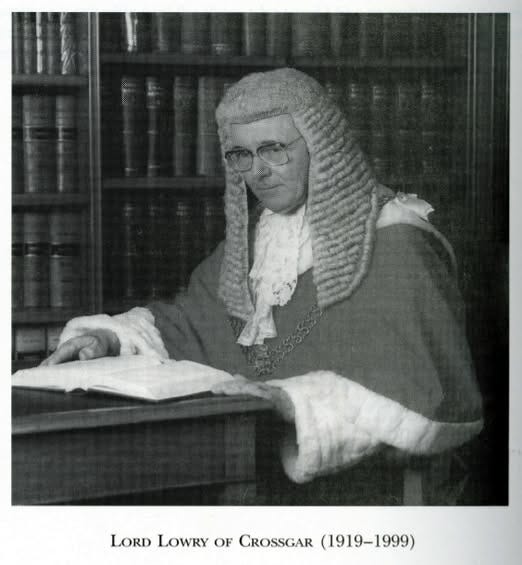
Northern Ireland Lord Chief Justice Lord Lowry was attacked by the IRA as he paid a visit to Queen’s University of Belfast. The IRA fired several shots at Lowry, who was not injured, but a lecturer at the university was wounded by the gunfire.
March 5th.
IRA member Seamus Morgan (24) was shot and killed by fellow members of the IRA who alleged that he was an informer. His body was found near Forkhill in County Armagh.
March 11th.
Former UDR soldier Norman Hanna (28) was shot and killed by the IRA outside his workplace in Rathfriland, County Down.
March 25th.
British soldiers Daniel Holland (22), Nicholas Malakos (19), and Anthony Rapley (19) were killed, and five other people were injured in an IRA gun attack on Crocus Street, off the Springfield Road in West Belfast. It was believed that an M-60 machine gun was used in the attack.
March 27th.
UDA volunteer Stephen Boyd (25) was shot and killed by loyalists in the King Richard Tavern on the Castlereagh Road in Belfast.
March 28th.
RUC officer Norman Duddy (45) was shot and killed by the IRA shortly after leaving church on Patrick Street in Derry.
If you’d like to support the newsletter, why not buy me a ☕️ ?
Bombings in March 1982
March 14th.
The INLA stole 1,000 lb (450 kg) of Frangex commercial explosives from the Mogul Mines at Silvermines in County Tipperary.
March 15th.
Alan McCrum (11), a Protestant boy, was killed and 34 people were injured when the IRA exploded a bomb in Bridge Street in Banbridge, County Down. An inadequate warning had been given.
Thanks very much for reading. I hope you found it interesting and will come back on Sunday!
I appreciate everyone who recently clicked the heart icon ❤️ at the bottom. It makes it easier for others to find this newsletter.
Thanks for the support!
If you’d like to let me know what you think of today’s instalment, please comment below.
Some recommended reading based on research for this instalment.
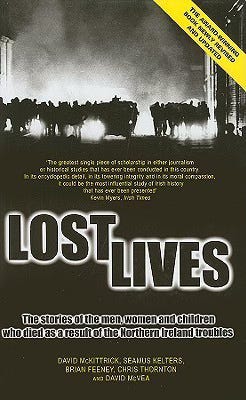
Lost Lives: The Stories of the Men, Women and Children Who Died as a Result of the Northern Ireland Troubles by David McKittrick, Chris Thornton, Seamus Kelters and Brian Feeney.