March 1981: Bobby Sands

Of all the things that happened in the world in March 1981, nothing compared to what was going on in Northern Ireland. Get comfortable, we’ve a lot to go through!
Political Developments in March 1981
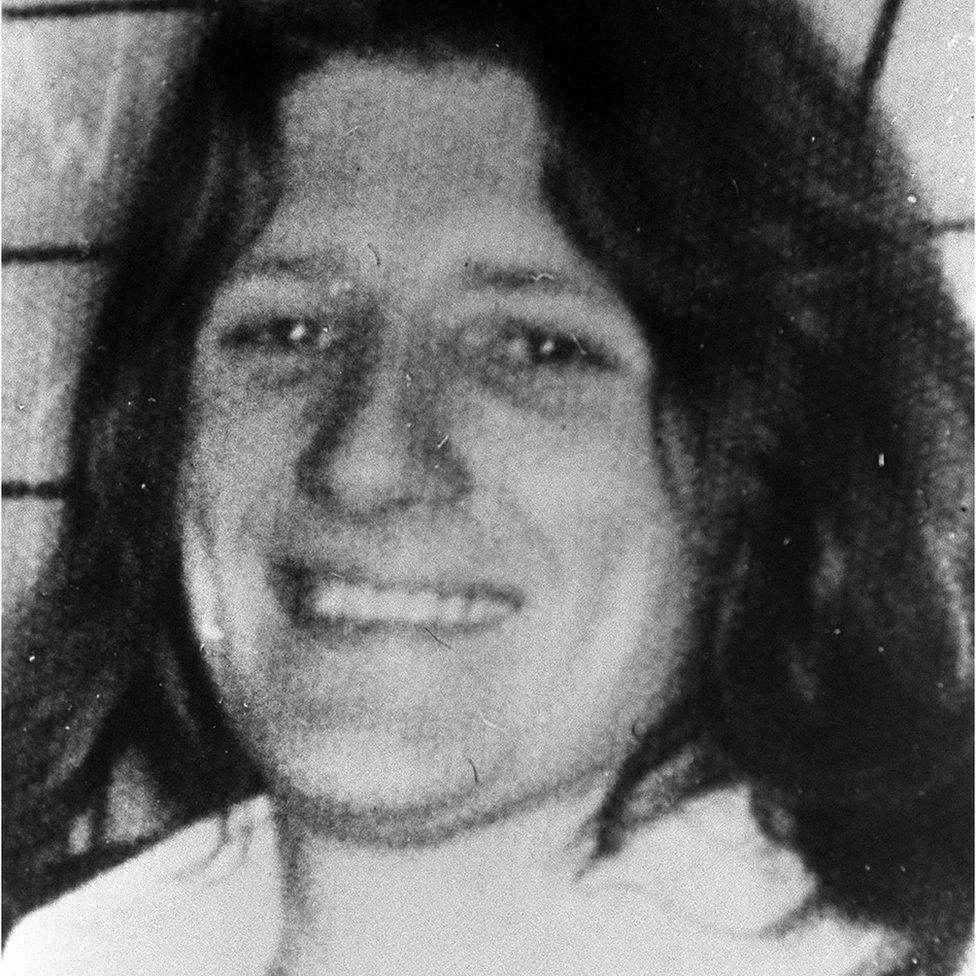
March began with IRA leader Bobby Sands in the Maze Prison refusing food, and so began a new hunger strike. The choice of the start date was significant because it marked the fifth anniversary of the ending of special category status (1 March 1976). The main aim of the new strike was to achieve the reintroduction of political status for Republican prisoners. Catholic Bishop of Derry Edward Daly criticised the decision to begin another hunger strike. Sands was to lead the hunger strike, but it was decided that Brendan McFarlane would take over Sands’ role as leader of the IRA in the Maze Prison. It later became clear that the IRA leadership outside the prison was not in favour of a new hunger strike following the outcome of the 1980 strike. The main impetus came from the prisoners themselves. The strike was to last until the 3rd of October 1981 and was to see 10 Republican prisoners starve themselves to death in support of their protest. The strike led to a heightening of political tensions in the region. It was also to pave the way for the emergence of Sinn Féin as a major political force in Northern Ireland.
The following day, Republican prisoners decided to call off the ‘blanket protest’ so as not to detract attention from the hunger strike.
On that same day, a meeting took place at the Maze prison regarding the hunger strike. The notes from the meeting were as follows;
NOTE OF A MEETING ON THE MAZE PRISON PROTEST ON 2 MARCH 1981
Progress of the Protest
It was confirmed that one prisoner, Sands, had been refusing food since yesterday. He had today asked to be moved to a single clean cell with bedding and this had been done. Sands is due to receive a statutory visit on 3 March from 3 visitors, one of whom has been identified as a journalist for the “Guardian”, David Beresford.
In addition to this action, Republican prisoners on the “dirty” protest have indicated that they will be coming off this protest and have asked to be moved to clean cells with bedding. It is expected that 250 prisoners will be in clean cells by tonight and the remainder by Wednesday. This could, however, be delayed by industrial action by the POA, which is trying to negotiate a “golden handshake” to compensate for the loss of special payments for cell cleaning, etc. It was confirmed that prisoners have not as yet requested furniture for their clean cells.
Action in hand
A brief, low-key press release responding to a statement by the prisoners about their change of tactics has been issued. The Secretary of State will be making a statement tomorrow. It has yet to be decided if this will be written or oral, although the advice of officials is that it should be the former. A decision on whether this statement should be sent to interested parties together with the press release has still to be decided.
Communications with Prisoners
Mr Barry’s paper on this subject was discussed. The two contentious areas were visits by lawyers and special visits. On visits by lawyers, it was agreed that these would have to be permitted but that action should be taken to query visits to the same prisoner by more than one lawyer; that an attempt should be made to discourage weekend visits; and that a full record of visitors should be kept. As far as special visits were concerned, it was agreed that requests would be considered in the light of prevailing circumstances.
Future Work
It was agreed that Messrs Barry, Palmer and Jackson should prepare a progress report for Ministers. There was considerable discussion on what line should be taken on whether or not prisoners moving into clean cells should also be entitled to receive furniture. It was agreed that the initial line should be that furniture should not be placed in cells at present, but that the matter would be considered on its merits if a special request was made.
It was agreed that a further paper should be prepared on the question of furniture, including matters such as availability and staff reaction, which would form the basis of a long-term decision on this issue.
There was also an extract from a medical officer’s journal that day, recording Bobby Sands’ current condition.
EXTRACT FROM MEDICAL OFFICER’ S JOURNAL
ROBERT GERARD SANDS - NO.C/950/77 H.3 BLOCK
The above-named prisoner today declared himself on hunger strike.
Medical observations are as follows:-
Weight: 64kg
B/p: 116/70
Pulse: 78
Urine: Ketones ++ Albumin nil
Dehydration: Nil
condition satisfactory.
On the 3rd of March, Secretary of State for Northern Ireland Humphrey Atkins made a statement in the House of Commons in which he said that there would be no political status for prisoners regardless of the hunger strike.
Independent Member of Parliament for Fermanagh / South Tyrone Frank Maguire died on the 5th of March. In the aftermath of his death, there was some debate amongst Nationalists as to the possibility of an agreed candidate for the forthcoming by-election. Initially, Noel Maguire, Frank’s brother, SDLP member Austin Curry, and Bernadette McAliskey all expressed an interest in standing for the vacant seat. However, McAliskey later stated that she would be willing to step down in favour of a candidate chosen by the prisoners in the H-Blocks. Eventually, the leadership of Sinn Féin decided to put forward a candidate, and on the 26th of March, Bobby Sands was nominated.
British Prime Minister Margaret Thatcher paid a visit to Northern Ireland on the same day and denied claims that the constitutional position of Northern Ireland would be threatened by the ongoing talks between the British and Irish governments.
The minutes from the Northern Ireland Office weekly bulletin that day also had some very interesting quotes.
“Hunger strikes to the death, if necessary, will begin from March 1, the fifth anniversary of the withdrawal of political status in the H Blocks and Armagh jail.”
“We are demanding to be treated as political prisoners, which everyone recognises we are.”
Statement attributed to the Maze and Armagh Prisoners on the 5th of February.
“Britain must somehow be made to realise that it is not the kind or colour of prison clothes that matters but that the whole process of criminalisation must be ended.”
“We have asserted that we are political prisoners and everything about our country, our arrests, interrogations, trials and prison conditions show that we are politically motivated… As further demonstration of our selflessness and the justice of our cause, a number of our comrades, beginning today with Bobby Sands, will hunger strike to the death unless the British Government abandons its criminalisation policy and meets our demands for political status.”
Statement by the National H Block Committee reported by the Irish News.
“Highlight the main areas of our demands which are not about cell furniture or toilet facilities but about the right not to wear prison uniform in the H blocks and, in both the H blocks and Armagh Prison, the right not to do prison work and the right to free association with fellow political prisoners (which includes segregation from loyalists)… Nevertheless, as from today, we are prepared to run that gauntlet /assaults by prison officers to highlight the hunger strike and the issues behind our demands for political status.”
Press statement by Republican prisoners on the 2nd of March regarding the clean protest.
On the second day of Margaret Thatcher’s visit to Northern Ireland, she had an interview with ITN.
INTERVIEW WITH ITN
Interviewer: Prime Minister, you came over here to assure the people of Northern Ireland. You don’t seem to have been able to reassure the hard-line Protestants. Why do you think that is?
PM: I don’t know that it is possible to reassure everyone. What I hope is that it is possible to reassure the vast majority. Two things: first, the guarantee to the people of Northern Ireland is the law of our land, it is in the 1973 Act, and I give my personal commitment to it. That I wanted to get over. Secondly, I also believe very much that we have a duty to try to live in peace and reconciliation with the only neighbouring country with whom we have a land border. We shan’t be deflected from that either. I wanted to make both perfectly clear.
Interviewer: Mr Paisley says he will only accept your assurances if you announce that you are not discussing the totality of relationships with Dublin.
PM: I cannot answer for Mr Paisley. I can only answer for myself.
Interviewer: But can you give him that reassurance?
PM: I can only answer for myself and for the Government. No. The communique was drawn up after the last summit meeting in Dublin. The communique stands, and now that talks will be entered into as a result of that communique, entered into. Nothing firm was decided. We shall talk together.
Interviewer: Is not totality bound to include some minor, perhaps, constitutional questions?
PM: None at all. We are not discussing constitutional questions. The word does not appear in the communique.
Interviewer: Totality includes everything.
PM: I am sorry the word constitutional is not included in that communique, and was purposely not because it is against the present framework, which is part of the law of our land. The constitution of Northern Ireland is in the law of our land.
Interviewer: What will you discuss? An Anglo/Irish defence pact, for instance?
PM: We haven’t raised that with the Republic of Ireland. It would not be a matter for us. Defence would be a matter for NATO as a whole, not a bilateral matter between the United Kingdom and the Republic of Ireland.
Interviewer: Do you believe there is, in fact, anything you could say which could well reassure Mr Paisley?
PM: I can’t answer for Mr Paisley. I can only say that I hope to reassure the vast majority of people in Northern Ireland.
Interviewer: He has accused you of treachery and of being a liar. What do you make of that?
PM: He must be very desperate.
Interviewer: What about his parade of 500 people with firearms certificates? Doesn’t that indicate that he has got some powerful support behind him?
PM: You must ask Mr Paisley about these things.
Interviewer: But, doesn’t it indicate he has got backing?
PM: I have said perfectly clearly that there is no plot, there is no sell-out. The guarantee for the people of Northern Ireland is in our law, it cannot be altered unless the people of Northern Ireland wish it and the Parliament at Westminster changes it. It is in our law. Perhaps I had not realised enough that although it is in our law, the people of Northern Ireland need the reassurance given just a little bit more often.
Interviewer: Finally, to the hunger strike. Are you concerned here, alas, the IRA this time back it up with a bombing campaign?
PM: I am deeply sorry there is another hunger strike. It is to try to achieve political status for criminals. It will never achieve that status. Criminals are criminals. To me, there is no such thing as political crimes. Murder is criminal. Violence is criminal. It will stay that way. That hunger strike will achieve nothing.
Interviewer: Will they back it up with bombing?
PM: I do not know. I hope not because the people who will suffer will be the people of Northern Ireland, and that will not help anyone. It will only bring great cruelty and suffering, and I believe that the people of Northern Ireland will know where that cruelty and suffering came from. It came from terrorists who are the enemies of democracy and freedom everywhere.
Interviewer: Thank you very much, Prime Minister.
On the 15th of March, Francis Hughes, an IRA prisoner in the Maze Prison, joined Bobby Sands on hunger strike.
Secretary of State for Northern Ireland Humphrey Atkins sent a letter to the Catholic Archbishop of Armagh and Primate of All Ireland, Tomas O’Fiaich, on the 18th, regarding the ongoing hunger strike.
Dear Cardinal O’Fiaich,
Thank you for your letter of 28 February in which you record some of the points which you made during our meeting on 18 February and register your concern at the possible consequences of a second hunger strike.
As regards your four points, I commented at our meeting that:-
(a) The kind of meeting that you had in mind might actually serve to strengthen the hands of the “leaders” within the prison rather than weaken them.
(b) The prison authorities and the Government do not, in fact, require that a prisoner be deprived of all privileges for breaches of prison rules. When, following the authorities’ initiative, 96 prisoners accepted clean cells and furniture in January, the scale of punishment was reduced, with the rate of loss of remission halved, and the addition of an extra parcel per month. This reduction was notified to all protesting prisoners in writing on 21 January, so the general point you are making is not only accepted, but the authorities have given practical and public expression to it.
This scale is currently being applied to all those prisoners who have stopped fouling their cells.
So far as leisure clothing is concerned, I am afraid it is simply not the position that the prison authorities refused to allow the protestors to wear their own clothes because the latter refused to wear prison-issued civilian garb in working hours. As I said in my statement of 23 January, the 20 prisoners in question refused inter alia to take part in work other than that of cleaning their own cells and receiving full-time education. In other words, this group sought to bring about a situation in which they, not the prison authorities, determined what they should and should not do; and their determination was to the effect that they be relieved of all the communal chores of running a prison which would therefore have to continue to be spread among the balance of the population while at the same time they enjoyed the privilege of wearing their own clothes.
(c) While, obviously, I would pay close attention to what people of goodwill had to say about the circumstances in which a hunger strike might be averted, and the protest ended, I had to pay attention also to what the protestors themselves said or, apparently, allowed to be attributed to them. They had made it only too clear what kind of status, and what kind of prison regime they wanted: neither were matters which the Government could concede
(d) There was no difference of substance between the two statements you referred to. The point was simply that on 19 December, stocks of civilian-type clothing were not yet available and that prisoners ending their protest then would have to be issued with the old-style prison uniform. The undertaking was to provide the new-style civilian clothing as quickly as possible, and, as you know, that undertaking was fully honoured.
As regards your final paragraph, I wholeheartedly share your concern for the innocent in the community. I am bound to say, however, that I do not think you do justice to the efforts that the Government has made over the past year towards easing the situation in the Maze and Armagh Prisons. This second hunger strike has been entered into explicitly in pursuit of an objective - political status - which commands no support from any responsible quarter that I know of, and which the prisoners themselves must surely realise the Government cannot concede. It is my belief that the great majority of the community who behaved with such restraint and good sense last autumn, not least because of the example set by so many Church and political figures inside and outside Northern Ireland, understand the position very clearly and where the responsibility for it really rests. It is my belief also that the same majority expect the Government to maintain its stance not to yield sound principles in the face of violence, whatever form that violence may take. The Government will maintain it, and I am sure it can count on your support in so doing.
Yours sincerely, Humphrey Atkins.
On the 21st of March, Tomás Ó Fiaich issued a statement calling upon the IRA to end its use of violence.
Just a day later, IRA prisoner Raymond McCreesh and the leader of INLA prisoners in the Maze, Patsy O’Hara, also joined the hunger strike.
That same day, Irish Foreign Minister Brian Lenihan said that the ongoing talks between the British and Irish governments could lead to a United Ireland in 10 years.
On the 26th of March, Bobby Sands was nominated as a candidate in the by-election in Fermanagh / South Tyrone on the 9th of April 1981.
Ian Paisley addressed a rally of an estimated 30,000 people on the 28th at Stormont to protest against the ongoing talks between the British and Irish governments.
The following day, the SDLP decided to withdraw the nomination of Austin Currie from the forthcoming by-election in Fermanagh / South Tyrone.
Noel Maguire decided to withdraw his nomination in the forthcoming by-election in Fermanagh / South Tyrone on the 30th. This decision meant that voters were faced with a straight choice between Bobby Sands and Harry West, the Unionist candidate.
There was also a meeting held to discuss the current situation at the Maze prison.
NOTE OF A MEETING ON THE MAZE PRISON PROTEST, MONDAY 30 MARCH 1981
Situation in Prison
The general situation remains quiet, and there has been no change in the condition of the hunger strikers.
Fermanagh/South Tyrone By-Election
It was reported that Sands had given his consent for the election at some stage (probably during a visit by his solicitor) and was now a candidate in the election. He has appointed an election agent, a Mr Owen Carron, and intends to stand as an Anti-H-Blocks/Armagh Political Prisoner.
It was accepted that Sands’ candidature was likely to pose particular problems in relation to the prison administration. The principal difficulties would relate to access to the prisoner by, for instance, his election agent. It also seemed likely that the media would demand access in order to fulfil the criteria of impartiality during an election campaign. While it was accepted that the authorities would have some measure of control, as Sands is now under medical supervision, it was agreed that it would be very difficult to treat him as an ordinary prisoner during this period. It was agreed that the possible consequences should be considered urgently, and a paper prepared for Wednesday’s meeting, which would form the basis of our advice which might be given to the Governor on this subject.
Situation Outside the Prisons
It was reported that the support for the hunger strikers remains low-key. Demonstrations continue to be thinly attended and generally peaceful.
Publicity
In the absence of Mr Wyatt and Mr Gilliland, there was no report on the possibility of a PQ to cover the release of the leaflet on prison regime, which had been discussed at Friday’s meeting. It was agreed that the release of prisoners as a result of decision on restoration of remission should not be the subject of even a brief press notice but should be regarded as routine.
There were also documented details of concerns surrounding Sands’ election candidacy.
ROBERT SANDS - ELECTION CANDIDATE - IMPLICATIONS
I refer to my earlier minute of today’s date, recording the acceptance of ROBERT SANDS as a candidate in the Fermanagh/S Tyrone election on 9 April.
There are a number of foreseeable problems for the Secretary of State and the Prison Authorities which arise from Sands becoming an election candidate. These issues arise under the generic title of “access” but can be subdivided into three -
(a) access to Sands by his election agent;
(b) correspondence with Sands in connection with the election;
(c) access to Sands by representatives of the media.
Different issues arise should Sands be elected, but these need not concern us at this stage.
Sands and his Election Agent
There is no specific provision in the Prison Rules on this point. It is therefore a matter for the discretion of the Governor. As refusal of reasonable access will produce parliamentary criticism, it is recommended that access to Sands by his election agent should be as free as possible, consistent with the prison’s capacity to handle such visits without undue disruption and also subject to any medical advice in connection with Sands’ condition.
Correspondence with Sands
There is likely to be pressure for greater correspondence both to and from Sands in connection with the election. It is also likely that the request would include a provision for no censorship. No relaxation in the present rules about correspondence is suggested, though it may be that we will have to give special consideration to Sands’ election address, which will qualify for free distribution by the Post Office.
Access to Sands by representatives of the media
There is likely to be early pressure for journalists, TV and others to have access to Sands to enable him to present his election case. In the case of the BBC, the issue of fair and equal treatment of all candidates will be raised. No relaxation of the present arrangements for access to Sands is proposed. In answer to the BBC “fair treatment” point, our line should be that this is the BBC’s problem, not ours. This may well result in no television coverage for either of the election candidates.
We are at present unaware of any English precedents of convicted prisoners running for election. There are Northern Ireland precedents in 1955 when Mitchell and Clarke fought and won two seats. The papers in these cases are being consulted and may indicate other likely problems in these circumstances, or precedents which should be taken into account.
Summary
Subject to taking into account any precedents, the Secretary of State is asked to agree/that our line in respect of requests for access to Sands as an election candidate should be as follows-
(a) As free and flexible as possible between Sands and his election agent;
(b) No concessions at this time on correspondence;
(c) No concessions at this time on access by the media.
March finished with a letter from Mr D. Gilliland to Mr Wyatt on the 31st of December.
ROBERT SANDS ELECTION CANDIDATE
Mr Palmer, in his minute of 30 March, raises the question of access to Sands by representatives of the media. I have discussed this with Mr Palmer and agree with his paragraph 6. While my own view is that we must be very firm regarding Sands as a convicted criminal, I anticipate very strong arguments being put forward on his behalf in favour of his being allowed to present his case to the media.
This opens up a very large can of worms. Are we preventing a potential Member of Parliament from putting his case to the electorate? Are we therefore subverting the democratic process? Would he have a case if, following the election, assuming he were defeated, forgoing to the High Court and claiming that he was prevented from carrying out his election campaign? Could he, in fact, delay the election if such a case were put before 9 April? These are questions to which I do not know the answers, but so far as the media are concerned, I believe we must regard Sands primarily as a convicted criminal who is, while in prison, subject to the same prison rules and discipline as any other person. While a Member of Parliament may have privileges, a person who is simply running for Parliament presumably does not.
I have already refused a formal request from BBC 2 “News Night” to (a) interview Sands as a candidate; (b) film Sands without an interview; or (c) take still photographs of him in the prison. Subject to views, I propose for the immediate future to maintain that line in the face of what I would forecast to be a considerable number of such requests.
Tales of the Troubles is a reader-supported publication. Join hundreds of subscribers and get every instalment straight to your inbox 3 times a week.
Shootings in March 1981
March 19th.
Civilian, Gerry Rowland (40) was shot by an IRA sniper while travelling in a car with an off-duty UDR member, near Crossmaglen, County Armagh.
March 20th.
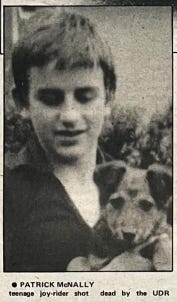
Patrick McNally (20), a Catholic civilian, was shot and killed by the Ulster Defence Regiment while he was ‘joyriding’ in a stolen car on the Ross Road in the Lower Falls Road area of Belfast.
March 25th.
The INLA shot and seriously wounded Belfast city councillor Sammy Millar in his Shankill Road home. He was a member of the Ulster Democratic Party, the UDA’s political wing. The attack left him permanently disabled.
March 26th.
The INLA shot a man in the leg in the Market area of Belfast “for jeopardising an active service unit”.
March 27th.
The IRA shot and killed off-duty UDR soldier John Smith (25) on Cromac Street in the Market area of Belfast.
The UDA shot and killed Catholic civilian Paul Blake (26) on Berwick Road, Belfast.
If you’d like to support the newsletter, why not buy me a ☕️ ?
Bombings in March 1981
No bombings to report.
Thanks very much for reading. I hope you found it interesting and will come back on Sunday!
I appreciate everyone who recently clicked the heart icon ❤️ at the bottom. It makes it easier for others to find this newsletter.
Thanks for the support!
If you’d like to let me know what you think of today’s instalment, please comment below.
Some recommended reading based on research for this instalment.
Lost Lives: The Stories of the Men, Women and Children Who Died as a Result of the Northern Ireland Troubles by David McKittrick, Chris Thornton, Seamus Kelters and Brian Feeney.