June 1984: “Incinerated”
June 1984 opened against a backdrop of global upheaval. As Northern Ireland grappled with its own entrenched divisions, the world watched India descend into crisis during Operation Blue Star, the dramatic and deadly assault on the Golden Temple in Amritsar. The images of a state confronting an armed insurgency inside one of its most sacred sites echoed uncomfortably with the tensions simmering closer to home. In Northern Ireland, June brought its own collisions of politics, violence, and rhetoric, from high‑level diplomacy to incendiary local outbursts, revealing once again how fragile the line was between governance, grievance, and force.
Political Developments in June 1984
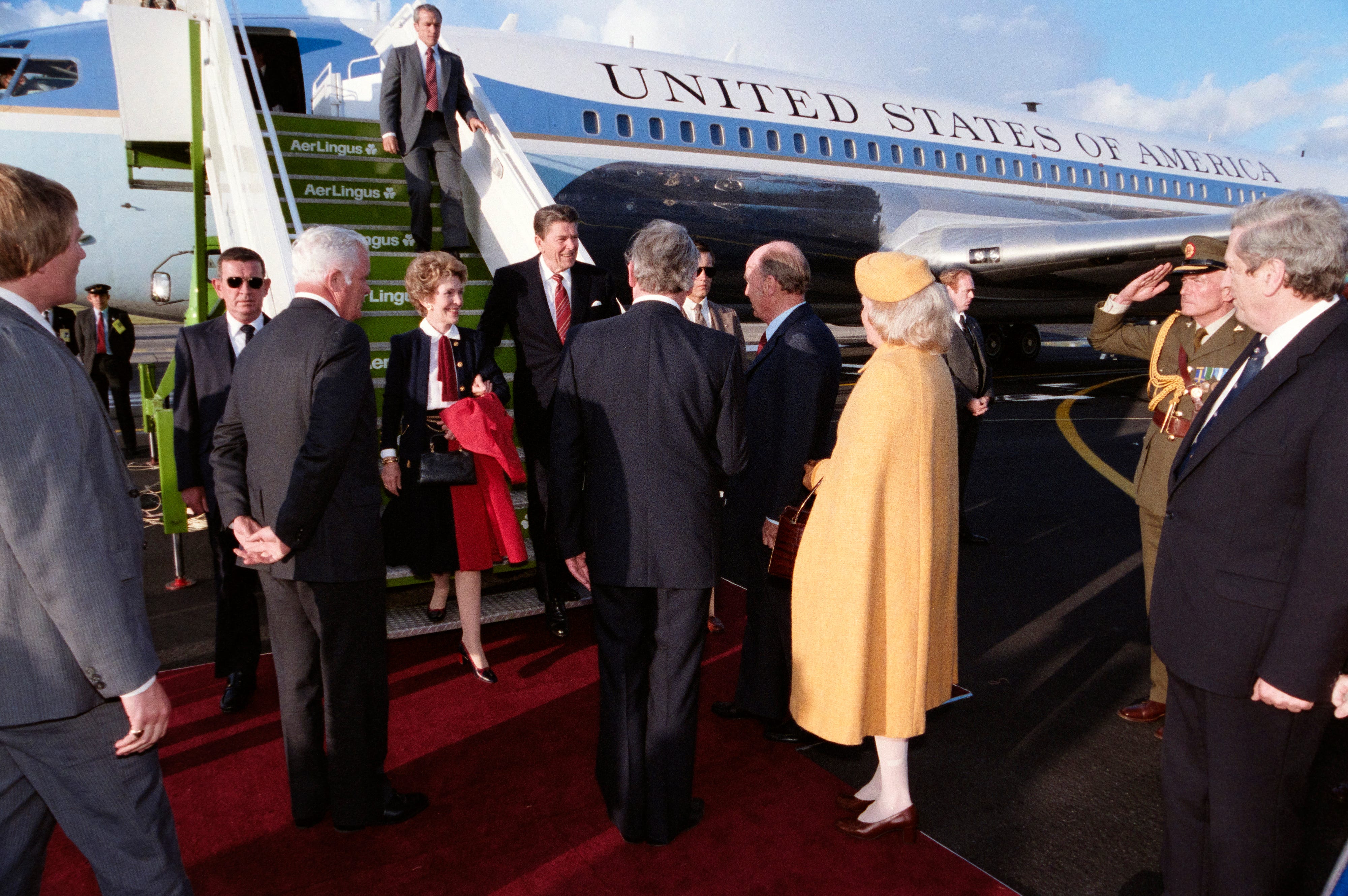
June opened with a major diplomatic moment as US President Ronald Reagan began a four‑day visit to the Republic of Ireland. On the 4th, he addressed a joint session of the Dáil and Seanad in Dublin, stressing that the United States would not interfere in Northern Ireland’s internal affairs. He condemned the ongoing violence, however, and voiced support for the New Ireland Forum.
The following day, controversy erupted in Belfast when Loyalist councillor George Seawright told a meeting of the Belfast Education and Library Board that Catholics and their priests should be “incinerated.” The DUP swiftly withdrew the party whip from Seawright in response to the remarks.
That same day, three RUC officers were acquitted of the 1982 murder of Eugene Toman (21), an unarmed IRA member shot at an RUC checkpoint. Two other IRA members were killed in the same incident. In delivering his judgment, Lord Justice Gibson said the officers should be commended “for their courage and determination in bringing the three deceased men to justice, in this case to the final court of justice.” His comments provoked anger among many Nationalists.
On the 14th of June, Northern Ireland went to the polls for the European Parliament election, with the entire region treated as a single constituency under proportional representation. When counting concluded, DUP leader Ian Paisley, UUP member John Taylor, and SDLP leader John Hume were elected as MEPs from a field of eight candidates.
Labour Party leader Neil Kinnock stated on the 20th that he supported the principle of a united Ireland achieved by consent.
June closed with a shift in security thinking, as officials explored a more data‑driven approach to understanding patterns of violence and policing in Northern Ireland. Notes from a meeting held on the 29th recorded the following:
SECURITY POLICY REVIEW WORKING GROUP: SUB-GROUP ON STATISTICS
Summary note of a meeting held on Friday, 29 June in the Conference Room of Stormont House Annexe.
Introduction
1. Mr Davies explained the general background to the establishment of the Sub-Group. The Group had 2 main tasks:-
a. to comb through the statistical material that had already been circulated with a view to identifying any significant trends and any ways of presenting them clearly to the Working Group;
b. to assess whether there might be any scope for using OR expertise in the study of resource utilisation in relation to these trends.
2. Mr Davies commented that the conceptual theme before the Sub-Group was not so much that of what total level of resources should be devoted to law, order and protective services in Northern Ireland, but rather that of how to make the most effective use of whatever resources were available. The former question was of great importance and was being pursued separately. The Working Group wished to know whether available statistical material gave any useful pointers to fruitful trends or successful outputs upon which we might build, or else to the necessity for changes in resource allocation to overcome continuing difficulty or to avoid developing problems.
Discussion
3. In the course of the discussion which followed, Dr Mulligan indicated that the trends and topics of most significance which emerged from existing data, or indeed data in preparation seemed to be as follows:-
a. evidence of a ‘hardening’ in terrorist expertise;
b. the comparatively low level of performance (measured in relation to indictable crimes cleared per officer) of the RUC by comparison with forces, for example, in England and Wales. These would require explanation and analysis, notably on a regional basis. Work on that is already in hand and might go some way towards describing and explaining the difficulties confronting the police and the diverse demands that are made upon them in different areas of the Province.
c. material on the interaction between ‘ordinary’ crime and terrorism should be presented in a readily assimilable form to help in the development of policy or operations;
d. trends in the performance of the criminal justice process in respect of, for example, bail and acquittal rates (scheduled and non-scheduled) and trends in sentencing policy to show the extent to which the ‘criminalisation’ policy has operated with impartiality and effectiveness before the courts;
e. recidivism rates also provided a measure of performance in the whole system and should be pointed up.
4. The Group also agreed that any statistical data on the comparative performance of different methods of approach to tackling crime should also be featured in a report to the Working Group. Chief Inspector Willis and Major Wilkinson undertook to check on whether any statistical data existed on, for example, the success rates of particular methods of operation (for example, in relation to patrolling or community relations), and on the efficacy of specific organisational structures in dealing with crime (for example,, by targeting specific problem areas or by working in teams).
5. So far as the use of OR expertise was concerned, the Group recognised that the ground for any study would have to be carefully prepared the topical topics for study would need to be clearly defined, and a feasibility study might be necessary in advance. It might be that the Treasury could be of direct assistance throughout, but the degree to which Treasury staff could help would be conditioned by the scale of the study and the timescale for its completion. It might be necessary to seek help from the Home Office of the MOD (DOAE, West Byfleet), who have the capacity to act on a consultancy basis. But the Treasury would certainly be in a position to advise on task definition and the most appropriate choice of expert help.
6. Mr Jones commented that in advance of the meeting, he had thought that it might be useful to examine the possibilities of studies on the following lines:-
a. a model of the typical ‘terrorist career’ with a view to identifying the point at which resource investments and intervention might most fruitfully be made;
b. the modelling of the interactive effects of different operational policies in particular areas. This approach had most in common with ‘war gaming’. The timescales were lengthy, but DOAE had a worthwhile track record.
c. a focus on output measurement and performance measurement - and in particular on assessing the different effects on the community of measures designed to obtain compliance and to build confidence as opposed to those designed for successful arrests.
7. The Sub-Group agreed that all of these suggestions were worthy of consideration by the Working Group. There were clear dangers, however, in attempting to conduct very lengthy studies that would have little or no bearing upon security policy as a whole. It might be that the first of Mr Jones’ suggestions could be subsumed in the statistical presentation on the hardening of the terrorist expertise. Similarly, the DOAE approach might be applicable to a specific geographic area in the Province which gives rise to continuing security problems. Again, the statistical presentation of performance factors by region might provide some useful pointers. Again, Mr Jones’ last suggestion on output measurement was wholly in conformity with the Sub-Group’s own approach - though it seemed likely that this would be the area in which statistical resources were the poorest.
Action
8. Dr Mulligan agreed to provide a readily assimilable statistical presentation on each of the key items listed at paragraph 3 above. He also agreed to send Mr Jones some further information on crime and criminal statistics with special reference to scheduled and non-scheduled offences. Mr Jones undertook to reflect on what steps might usefully be taken next from the point of view of using OR expertise. The Chairman agreed to make arrangements for Mr Jones to be briefed further by the security forces either during the course of his next visit to Belfast or some time soon after.
9. It was agreed that the Sub-Group’s programme of work should be submitted to the Working Group for their information and any necessary comment.
Next Meeting
10. The next meeting of the Sub-Group was provisionally arranged for 10 July - the time to be confirmed by NIO Law and Order Division, taking account of discussion at the Working Group meeting on 5 July.
Tales of the Troubles is a reader‑supported publication. Thousands read it — but only subscribers get every instalment, every detail, every story as it lands. Don’t be the one hearing about it second‑hand.
Shootings in June 1984
June 3rd.
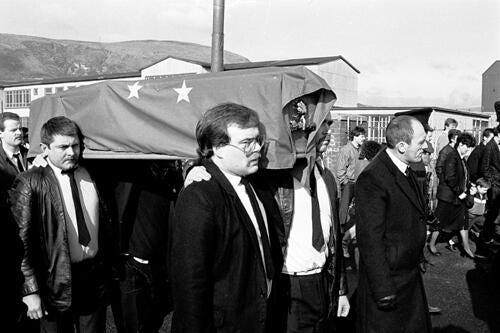
Taxi driver and ex-UDR soldier Hugh Gallagher (26) was shot and killed by the IRA. His body was found in his car on Faccary Road in Loughmacrory, near Omagh in County Tyrone.
June 4th.
Off-duty UDR soldier David Chambers (34) was shot and killed by an IRA sniper at Dollingstown, near Lurgan, while motorcycling to his workplace.
June 9th.
Alleged criminal James Campbell (33) was shot and killed by the IRA inside the Pound Loney Social Club on Conway Street in the Lower Falls area of Belfast.
June 15th.
RUC officer Michael Todd (22) and INLA volunteer Paul McCann (20) were shot and killed during a gun battle on Lenadoon Avenue in Belfast. The RUC had surrounded an INLA unit that had taken up position in a house. Two other RUC officers were reportedly seriously injured, and an AK-47 rifle recovered was forensically linked to an attack on a British Army patrol at Broadway in Belfast during May 1984.
June 22nd.
A British soldier was badly injured when he was shot in the neck by an IRA sniper on the Whiterock Road in Belfast.
If you’d like to support the newsletter, why not buy me a ☕️ ?
Bombings in June 1984
Thankfully, there were no incidents to report on during June.
Thanks very much for reading. I hope you found it interesting and will come back on Tuesday!
I appreciate everyone who recently clicked the heart icon ❤️ at the bottom. It makes it easier for others to find this newsletter.
Thanks for the support!
If you’d like to let me know what you think of today’s instalment, please comment below.
Some recommended reading based on research for this instalment.
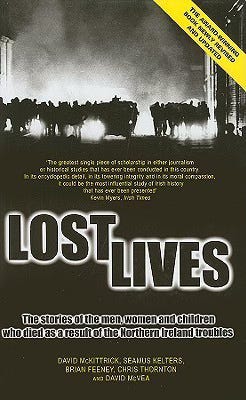
Lost Lives: The Stories of the Men, Women and Children Who Died as a Result of the Northern Ireland Troubles by David McKittrick, Chris Thornton, Seamus Kelters and Brian Feeney.