February 1985: Newry Mortar Attack
February 1985 unfolded under a grim shadow in Northern Ireland, as tensions deepened and violence continued to shape daily life. That same month, far beyond the streets of Belfast and Newry, the world witnessed a symbolic act of reconciliation: in Tunis, the mayors of Rome and Carthage formally signed a treaty ending the Third Punic War, a conflict that had lingered in name for over two millennia. The contrast was stark. While ancient enemies finally laid their feud to rest, the Troubles remained painfully present at home, reminding readers how elusive peace can be when history refuses to loosen its grip.
Political Developments in February 1985
February opened with a political shock. On the 1st, SDLP leader John Hume announced that he had accepted an invitation to meet the IRA, saying he intended to urge its leadership to end the campaign of violence. The decision drew immediate and heavy criticism from Unionists and others. When the meeting finally took place on the 23rd of February, it collapsed almost instantly: Hume walked out after the IRA suggested that part of the proceedings be recorded on video. He later said he had spent 28 hours “in the virtual custody of” the organisation from Friday evening until 8.00 pm on the Saturday, the time the meeting was due to begin, and that the encounter itself lasted only minutes.
Two days after Hume’s announcement, Irish Prime Minister Garret Fitzgerald warned that Republicans would use the proposed meeting for propaganda purposes. Fianna Fáil leader Charles Haughey, however, publicly backed Hume’s decision.
Tensions with the United States surfaced mid‑month. On the 16th, Sinn Féin President Gerry Adams was refused a visa to enter the USA, preventing him from addressing a planned meeting of members of Congress.
Security concerns continued to shape policy in Dublin. On the 19th, the Irish government introduced legislation allowing it to freeze the bank accounts of individuals suspected of holding funds on behalf of paramilitary organisations.
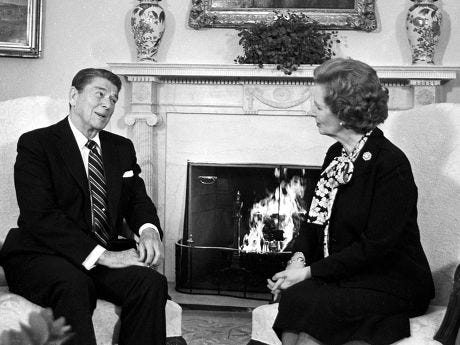
The following day, British Prime Minister Margaret Thatcher travelled to Washington and addressed the US Congress. In her speech, she urged Americans not to donate to organisations such as NORAID (Irish Northern Aid Committee), which were believed to channel support to Republican paramilitaries in Northern Ireland.
The month closed with political upheaval in the Republic. On the 25th, Des O’Malley, a Fianna Fáil TD, was expelled from the party for refusing to vote against a bill to liberalise contraceptive laws. His expulsion would ultimately lead to the formation of a new political force: the Progressive Democrats.
Tales of the Troubles is a reader‑supported publication. Thousands read it — but only subscribers get every instalment, every detail, every story as it lands. Don’t be the one hearing about it second‑hand.
Shootings in February 1985
February 1st.
The IRA shot and killed UDR soldier James Graham (39) in Derrylin, County Fermanagh. He had been driving a bus when an IRA volunteer shot him seven times through the front windscreen. Two other gunmen then entered the bus and shot him a further 24 times at point-blank range. Ulster Unionist MP Ken Maginnis stated that this was a “genocide – a conscious effort by the IRA to systematically wipe out Protestant families in the community”. The statement referred to the fact that two of Graham’s brothers, also UDR soldiers, had been killed by the IRA in 1981.
February 4th.
An RUC officer survived an IRA attack in County Fermanagh.
February 8th.
Civilian Gerard Logue (19) was shot and killed by the RUC while sitting in a stationary stolen car on Fort Street in Belfast.
February 17th.
Prison officer Patrick Kerr (37) was shot and killed by the IRA as he was leaving Saint Patrick’s Cathedral in Armagh town. He was shot three times in the head at point-blank range.
February 18th.
The UVF shot and killed Protestant civilian Mark Rossborough (21) and left his body in a rubbish dump on Ballygomartin Road in Belfast.
February 21st.
RUC officer Francis Murphy (30) was killed when the IRA ambushed his vehicle at Drumsallen, near Armagh town. Three gunmen attacked the vehicle with machine guns. They had taken over a house on the road and had been lying in wait. The unit fired 36 shots.
February 23rd.
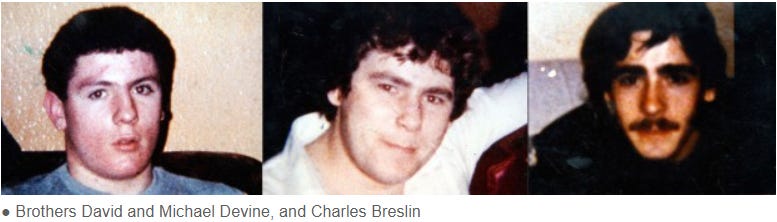
Charles Breslin (20) and two other IRA volunteers (Michael Devine (22) and David Devine (17)) were shot and killed in a British Army/SAS ambush in Strabane, County Tyrone. Two other IRA volunteers managed to escape. The men were returning weapons to an arms dump when they were shot.
Derry civilian Kevin Coyle (24) was shot and killed by the IRA at Corporation Street in the Bogside area. He was an alleged British informant.
February 24th.
The INLA shot and killed former UDR soldier Douglas McElhinney (40) on Glenvale Road, off the Northland Road, in Derry.
If you’d like to support the newsletter, why not buy me a ☕️ ?
Bombings in February 1985
February 8th.
An IRA landmine failed to injure three RUC officers in County Tyrone.
February 17th.
The INLA were responsible for several bomb hoaxes in Belfast.
February 27th.
An INLA van bomb destroyed a petrol station near Windsor Park in Belfast. Earlier in the day, the English football team played a match against Northern Ireland at the stadium, and an INLA statement warned that there would be further such attacks. Several high-profile sporting events were cancelled as a result.
February 28th.
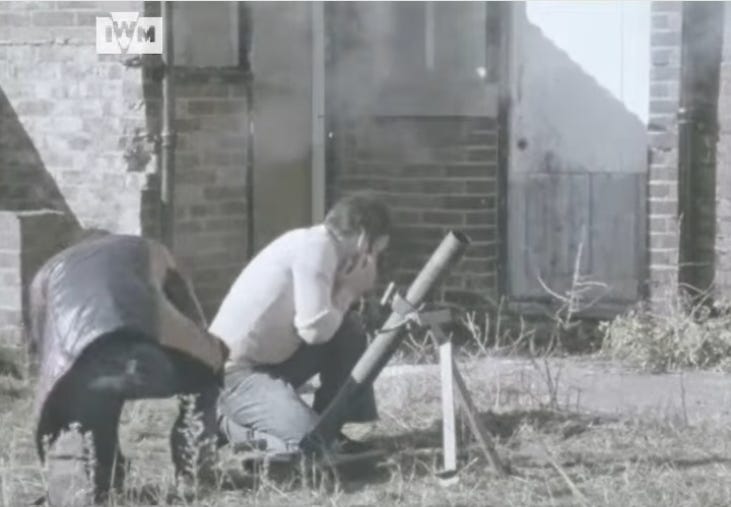
The IRA carried out a home-made mortar attack on the RUC station in Newry, County Down. The attack was jointly planned by members of the South Armagh Brigade and an IRA unit in Newry. The home-made mortar launcher, dubbed the ‘Mark 10’, was bolted onto the back of a Ford lorry that had been hijacked in Crossmaglen. Shortly after 6.30 pm, nine shells were launched from the lorry, which had been parked on Monaghan Street, about 250 yards (230 m) from the base. At least one 50 lb (23 kg) shell landed on a portacabin containing a canteen, where many officers were having their evening tea break. Nine police officers were killed and 37 people hurt, including 25 civilian police employees; the highest death toll inflicted on the RUC in its history. The nine dead officers ranged in age from 19 to 41, seven male and two female, seven Protestants and two Catholics. Another shell hit the observation tower, while the rest landed inside and outside the perimeter of the base. Those who lost their lives were Alexander Donaldson (41), Rosemary McGookin (27), Geoffrey Campbell (24), Denis Price (22), Paul McFerran (33), Sean McHenry (19), David Topping (22), John Dowd (31) and Ivy Kelly (29).
UDR soldier Trevor Harkness (36) was killed by an IRA booby-trap bomb hidden in a telegraph pole in Pomeroy, County Tyrone. Two other UDR soldiers were injured.
Thanks very much for reading. I hope you found it interesting and will come back on Sunday!
I appreciate everyone who recently clicked the heart icon ❤️ at the bottom. It makes it easier for others to find this newsletter.
Thanks for the support!
If you’d like to let me know what you think of today’s instalment, please comment below.
Some recommended reading based on research for this instalment.
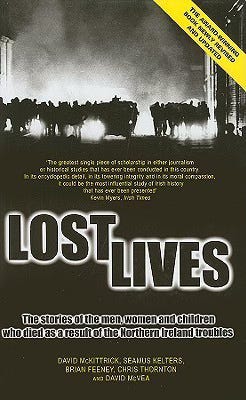
Lost Lives: The Stories of the Men, Women and Children Who Died as a Result of the Northern Ireland Troubles by David McKittrick, Chris Thornton, Seamus Kelters and Brian Feeney.