February 1981: "Liar!"

February 1981 saw the “Tejerazo” Spanish coup led by Civil Guard officer Lieutenant Colonel Antonio Tejero Molina fail after a televised speech by King Juan Carlos I. Meanwhile in Northern Ireland, fractures continued to appear in the political framework…
Political Developments in February 1981
February began with a statement from Republican prisoners warning that there could be further hunger strikes if they were not granted special category status.
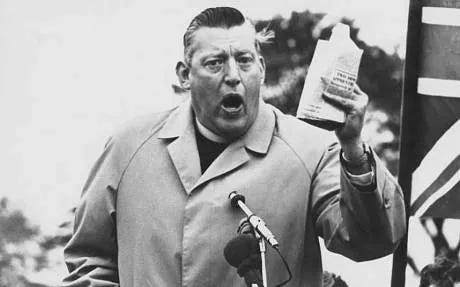
On the 6th of February, DUP leader Ian Paisley led a group of 500 men up a hillside in County Antrim at night. Those taking part in the gathering were photographed holding firearms certificates above their head. The Royal Ulster Constabulary issues firearm certificates to those people who possess legally held firearms. The demonstration implied that those taking part could as easily have been holding their weapons above their head.
3 days later, Ian Paisley and other senior members of the DUP held a rally at Belfast City Hall where they signed a covenant, the ‘Ulster Declaration’, based on the Ulster Covenant of 1912. Paisley also announced a ‘Carson Trail’, a series of protest rallies against the ongoing dialogue between British Prime Minister Margaret Thatcher and Irish Prime Minister Charles Haughey.
On the 10th, Minister of State at the Northern Ireland Office Adam Butler wrote a letter to Under-Secretary at the Department of Industry Norman Tebbitt regarding the Toshiba Semiconductor Project.
Dear Norman,
TOSHIBA - SEMICONDUCTOR PROJECT
I refer to Alex Fletcher’s letter to you of 22 January.
As you know, Northern Ireland shares with Scotland a need for a sustained inflow of new investment as the existing manufacturing base is shrinking with alarming rapidity and is quite incapable, of itself, of generating sufficient growth to produce sufficient new jobs in the short time-scale necessary. I believe that we have to look to overseas investment in high-growth, high technology sectors to produce the jobs we need, bearing in mind that less sophisticated operations, which have been an important element of new investment in the past, are now more likely to locate in low labour cost areas. I am conscious that we are at a disadvantage in attracting investment from GB itself because perceptions there remain heavily influenced by media reporting on Northern Ireland, which produces such a discouraging atmosphere for potential investors.
I therefore have a special interest in the general principle which Alex’s letter illustrates. I support his contention that, before a decision is taken to withhold selective assistance from an incoming project solely on grounds of potential damage to domestic manufacturers, there should be an exhaustive examination of the implications. Substantiation that damage may result should not, in my view, of itself justify refusal: we should also need to weigh the potential benefit of the newcomer to the regional and. national economy (does he, for example, bring efficiency and technology gains and enhanced potential for future growth?) and the likelihood that from an alternative base elsewhere in the EEC he would be in a position to do equal harm to domestic producers. It might also be proper to look for assurances in regard to his export policy.
On the Toshiba case, I would make the general point that a decision to exclude such a project must be taken in the light of any possible adverse effects on Japanese willingness to consider the UK for future investments.
COMMERCIAL IN CONFIDENCE
Northern Ireland has so far been unsuccessful in its attempts to attract investment from Japan, but we are working hard to change this, and I am anxious that we lose no opportunity to establish a foothold in what is likely to be a major source of inward investment in the years to come.
I am copying to Alex Fletcher and the other recipients of your letter.
DUP Leader Ian Paisley was suspended from the House of Commons on the 12th of February when he repeatedly called Secretary of State for Northern Ireland Humphrey Atkins a liar.
A week later, UUP Leader James Molyneaux dismissed as ‘ludicrous’ claims by Ian Paisley that the UUP were conspiring to kill him.
On the 23rd of February, a confidential internal RUC memo about the Walker Report contained instructions that the report’s recommendations should be implemented on the 1st of March 1981.
Tales of the Troubles is a reader-supported publication. Join hundreds of subscribers and get every instalment straight to your inbox 3 times a week.
Shootings in February 1981
February 6th.
RUC officer Charles Lewis (36) was shot and killed by the IRA while standing outside a shop, during a foot patrol on Balmoral Avenue, Malone, Belfast.
February 8th.
The INLA shot and killed RUC officer Alexander Scott (36) on My Lady’s Road, Belfast.
February 10th.
Off-duty UDR soldier David Montgomery (27) was shot dead by the IRA at his workplace, a timber yard, on Strand Road, Derry.
February 22nd.
Patrick Trainor (28), a Catholic civilian, was found shot dead on waste ground, off Glen Road, Andersonstown, Belfast, as an alleged informer. It’s reported that the IRA were responsible.
February 23rd.
The UVF shot dead Provisional IRA volunteer James Burns (33) at his home on Rodney Drive, Belfast
If you’d like to support the newsletter, why not buy me a ☕️ ?
Bombings in February 1981
February 6th.
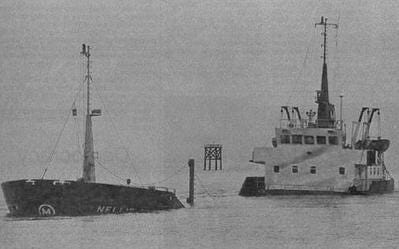
The IRA bombed and sank a British coal boat, Nellie M, off the coast at Moville, County Donegal, Republic of Ireland.
February 21st.
The IRA carried out a series of fire bomb attacks on eight shops in Belfast and three in Derry, which resulted in damage to all 11 stores.
February 27th.
A large van bomb exploded in the centre of Limavady, County Derry, causing damage to 40 premises. It was believed that the IRA were responsible for the attack.
Thanks very much for reading. I hope you found it interesting and will come back on Thursday!
I appreciate everyone who recently clicked the heart icon ❤️ at the bottom. It makes it easier for others to find this newsletter.
Thanks for the support!
If you’d like to let me know what you think of today’s instalment, please comment below.
Some recommended reading based on research for this instalment.
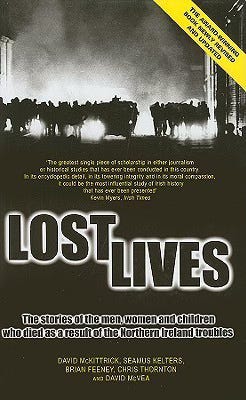
Lost Lives: The Stories of the Men, Women and Children Who Died as a Result of the Northern Ireland Troubles by David McKittrick, Chris Thornton, Seamus Kelters and Brian Feeney.