August 1984: “Grave Irregularities”
A month when the world was transfixed by the spectacle of the Los Angeles Olympics, August 1984 offered a rare moment of global celebration; Mary Lou Retton’s historic all‑around gold, Carl Lewis’s dominance on the track, and Joan Benoit winning the first women’s Olympic marathon all captured headlines and imaginations. Yet back in Northern Ireland, the summer unfolded under a very different kind of intensity: streets with persistent tensions, security operations continuing in the background, and communities navigating another month shaped by the long shadow of the Troubles. Setting these side by side, the world cheering athletic triumphs while Northern Ireland endured its own unresolved struggle, reveals the stark contrast between global unity and local fracture that defined August 1984.
Political Developments in August 1984

August opened with a note surrounding further measures to curb terrorism. The note read;
FURTHER MEASURES TO CURB TERRORISM
You will have seen that the Attorney General, in commenting on the conclusions of our Working Party, has noted that we did not recommend change in the law with regard to incitement to hatred; he shares the view of the Director of Public Prosecutions that the necessity to prove intent greatly limits possible use of the law, and wonders if the Secretary of State is prepared to consider further the removal of this requirement. The Director himself has also represented this interest to me, though I do not recall that it was put at all strongly by his representative in the Working Party.
I think that we discarded the possibility at an early stage (minutes 3: 23 February, page 6; document 2, pages 5-7) largely on the grounds that the purposes of the existing law were too particular to bear upon the generalised mischief of apologists for terrorism that we were charged to deal with. That is not to say that the change suggested might not have merit in itself. However we also noted that race relations law in GB, which has done away with intent, has not proved effective; that the removal of a requirement to prove intent could make the scope of the offence undesirably wide; and that since the offence was triable on indictment before a Jury, it could only be of limited value in cases with a terrorist context (in fact they could only be tried summarily). The Director has argued with me that the difficulties encountered in the race relations context would be less likely to arise here in the religious context (as it would normally be); but he has conceded that his options would normally be limited to summary trial, as indeed he has resorted to in the case of George Seawright.
All in all, I am not much impressed by the plea for reconsideration of this point. (Even the Standing Advisory Commission on Human Rights does not press it very urgently today), But it would be wrong to deny the Attorney without further ado. I suggest that the Secretary of State should be advised now to tell the Attorney that we will give the matter further thought, while having some reservations. We can then look at the proposition at some leisure. If you agree and others have no serious objections, I shall minute PS/Secretary of State accordingly.
August also saw renewed controversy over the presence of NORAID leader Martin Galvin, who appeared at a rally in Derry on the 9th despite being banned from entering the UK. Three days later, he surfaced again at a Belfast rally, prompting RUC officers to move in and arrest him. Reflecting on the affair, Secretary of State James Prior would later concede that banning Galvin had been “a bad mistake”.
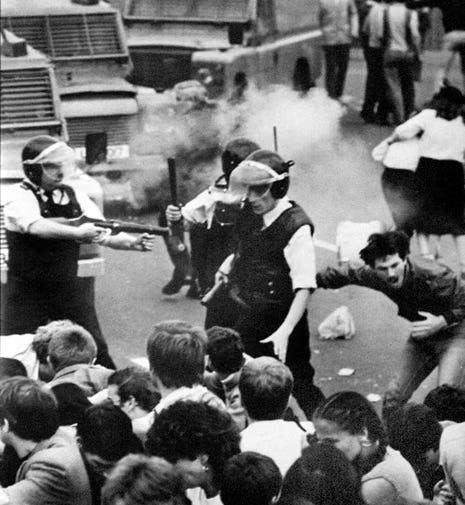
Tensions escalated further on the 13th, when west Belfast hosted a march in memory of Sean Downes, who had been killed the previous day by a plastic baton round fired by the RUC. The commemoration quickly gave way to serious rioting across the area.
Political debate intensified on the 17th, as Labour’s Northern Ireland spokesperson, Clive Soley, publicly called for the “harmonisation” of Northern Ireland with the Republic as a step toward eventual reunification.
The month closed with another shock to public confidence: Armagh coroner Gerry Curran resigned after uncovering “grave irregularities” in RUC files relating to the killing of two INLA members on 12 December 1982.
Tales of the Troubles is a reader‑supported publication. Thousands read it — but only subscribers get every instalment, every detail, every story as it lands. Don’t be the one hearing about it second‑hand.
Shootings, Riots & Other Deaths in August 1984
August 10th.
Garda officer Francis Hand (26) was shot and killed by the IRA in Drumcree, County Meath, during an attempted armed robbery of a post office.
UDA volunteer Benjamin Redfern (32) was killed while trying to escape from the Maze Prison. He was crushed to death in the back of a refuse lorry during the attempted escape.
August 11th.
An INLA attempt to ambush RUC officers failed, and a four-man INLA unit was arrested following a car chase in Dunmurry on the outskirts of Belfast.
August 12th.
During an altercation with protesters, an RUC officer fired a plastic baton round at close range and killed Sean Downes (22), a Catholic civilian.
August 13th.
The INLA claimed responsibility for a small arms attack on British soldiers at the junction of the Falls Road and Donegall Road in Belfast.
August 15th.
There were serious riots in Protestant areas of Belfast following protests against a ‘supergrass’ trial involving William ‘Budgie’ Allen. The riots would continue for three nights.
August 16th.
Loyalist paramilitaries opened fire on RUC officers on the Shankill Road as riots continued in Protestant areas of Belfast.
If you’d like to support the newsletter, why not buy me a ☕️ ?
Bombings in August 1984
August 8th.
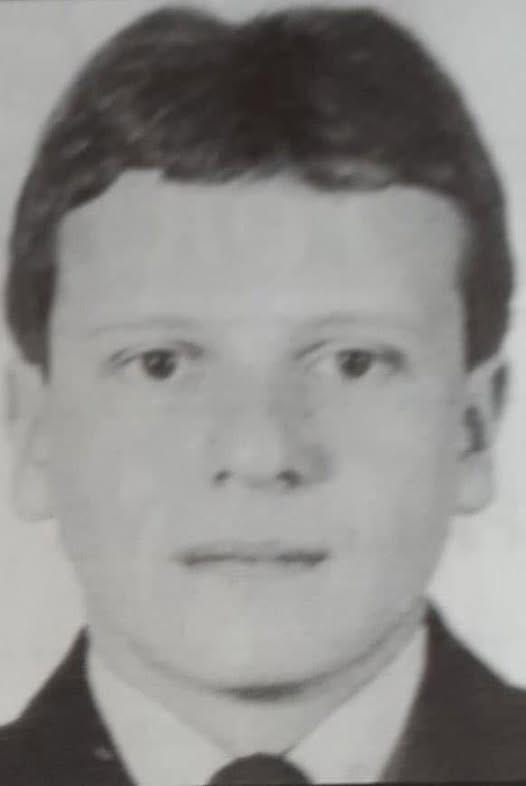
IRA volunteer Brendan Watters (24) died when a bomb he was handling prematurely detonated inside a house in Barcroft Park, Newry.
August 12th.
RUC officer Malcolm White (26) was killed in a land mine attack on an RUC mobile patrol in Crockanboy, Greencastle.
August 17th.
The INLA claimed responsibility for a 10 lb (4.5 kg) anti-personnel mine concealed near Areema Drive in the Twinbrook area of west Belfast. The group claimed only the detonator had exploded. The device was neutralised by the British Army in two controlled explosions.
Thanks very much for reading. I hope you found it interesting and will come back on Sunday!
I appreciate everyone who recently clicked the heart icon ❤️ at the bottom. It makes it easier for others to find this newsletter.
Thanks for the support!
If you’d like to let me know what you think of today’s instalment, please comment below.
Some recommended reading based on research for this instalment.
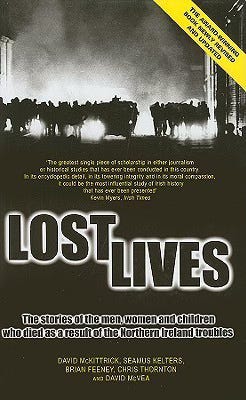
Lost Lives: The Stories of the Men, Women and Children Who Died as a Result of the Northern Ireland Troubles by David McKittrick, Chris Thornton, Seamus Kelters and Brian Feeney.